



By Dellendo Farquharson
Published: April 20, 2026
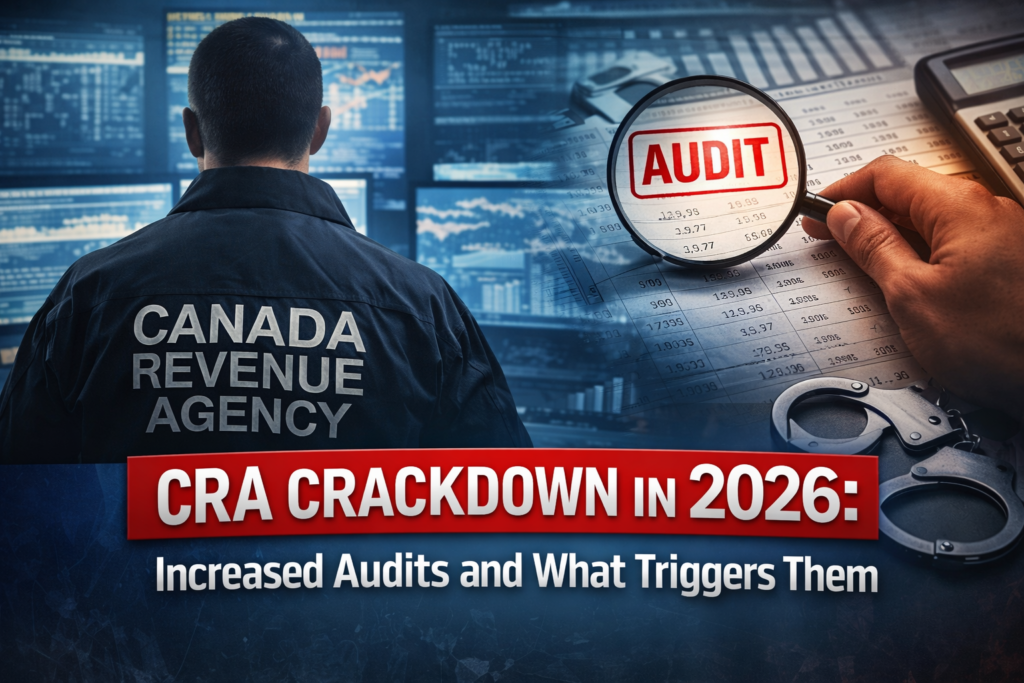
Canada’s tax environment in 2026 is marked by a clear shift: stronger enforcement, smarter data systems, and more targeted audits by the Canada Revenue Agency (CRA). For individuals, self-employed professionals, and business owners, this means one thing—compliance is under a sharper spotlight than ever before.
With the CRA expanding its use of artificial intelligence, data matching, and international information sharing, taxpayers can no longer assume that inconsistencies will go unnoticed. At BOMCAS Canada Accounting and Tax Services, we are seeing a noticeable increase in audit activity, review letters, and requests for supporting documentation across Canada.
Why CRA Audits Are Increasing in 2026
The CRA continues to invest heavily in digital tools that allow it to analyze large volumes of taxpayer data quickly and accurately. This includes cross-referencing income reported on tax returns with third-party data such as T-slips, financial institutions, online platforms, and international tax reporting systems.
As a result, audits are becoming more targeted rather than random. The CRA is focusing on areas where discrepancies, underreporting, or aggressive claims are more likely. This approach allows the agency to increase audit efficiency while expanding its reach across both individuals and businesses.
Top CRA Audit Triggers in 2026
Understanding what triggers an audit is one of the most effective ways to reduce your risk. While no system is perfect, certain patterns consistently draw CRA attention.
1. Unreported or Underreported Income
One of the most common triggers is failing to report all sources of income. This includes freelance income, side business earnings, rental income, cryptocurrency gains, and foreign income. The CRA’s systems are increasingly effective at identifying mismatches between reported income and third-party data.
2. Excessive or Unusual Expense Claims
Large or inconsistent deductions—especially when compared to industry averages—can raise red flags. This is particularly common with self-employed individuals claiming home office expenses, vehicle costs, and meals.
3. Repeated Business Losses
Reporting business losses year after year may lead the CRA to question whether the activity qualifies as a legitimate business or a hobby.
4. GST/HST Reporting Issues
Businesses that report inconsistent sales, late filings, or irregular GST/HST remittances are more likely to be reviewed.
5. Large Changes Between Years
Significant fluctuations in income, deductions, or credits from one year to the next can trigger a closer look.
Digital Tracking and AI Are Changing the Game
The CRA’s use of artificial intelligence is transforming how audits are selected and conducted. Instead of relying on manual review, the CRA now uses algorithms to identify patterns, anomalies, and risk indicators across millions of tax returns.
This means even small inconsistencies can be flagged automatically. For example, if your reported income does not align with industry norms or your expense ratios are unusually high, your return may be selected for review.
What Happens If You Are Audited
An audit does not always mean wrongdoing, but it does require immediate attention. The CRA may request documentation such as receipts, invoices, bank statements, contracts, and supporting schedules.
Failure to respond properly can lead to reassessments, penalties, and interest charges. In more serious cases, the CRA may expand the audit to additional years or related entities.
If you receive a CRA audit letter, it is critical to respond professionally and accurately. Many taxpayers benefit from professional representation to ensure their rights are protected and responses are handled correctly.
How to Reduce Your Audit Risk in 2026
While audits cannot always be avoided, there are clear steps you can take to minimize your risk:
- Report all sources of income accurately
- Keep detailed and organized records
- Ensure deductions are reasonable and well-supported
- File returns on time and pay balances promptly
- Work with experienced professionals for tax planning and filing
Taxpayers who stay organized and proactive are far less likely to encounter serious issues with the CRA.
What to Do If You Have Unfiled or Incorrect Returns
If you are behind on your taxes or believe past returns may contain errors, it is important to act before the CRA contacts you. The longer issues remain unresolved, the greater the risk of penalties and enforcement action.
Options may include correcting prior returns or applying through the Voluntary Disclosures Program (VDP). Professional guidance is essential in these situations to ensure the best possible outcome. For help getting back on track, visit late tax filing and penalty guidance.
How BOMCAS Canada Can Help
BOMCAS Canada Accounting and Tax Services provides expert support for individuals and businesses dealing with CRA audits, compliance reviews, and tax disputes. Our team helps clients prepare accurate responses, organize documentation, and navigate CRA processes with confidence.
We also offer proactive services including tax preparation, income tax filing, and full-service accounting and tax support to reduce audit risk before issues arise.
Final Thoughts
The CRA’s increased audit activity in 2026 is a clear signal that compliance matters more than ever. With advanced technology and stronger enforcement tools, the margin for error is shrinking.
For Canadians, the best strategy is simple: stay organized, report accurately, and seek professional advice when needed. In today’s environment, proactive tax management is not just a best practice—it is essential.










 View Our Location





 181 Meadowview Bay, Sherwood Park, AB T8H 1P7, Canada (Online Clients Only)