



Executive Summary
Canada’s cannabis industry operates in a uniquely complex tax environment. While recreational cannabis became legal in October 2018, the regulatory framework—particularly the excise duty system—was designed for a different market reality than what exists today. For cannabis producers, processors, and retailers, understanding the tax landscape is the difference between sustainable profitability and financial failure.
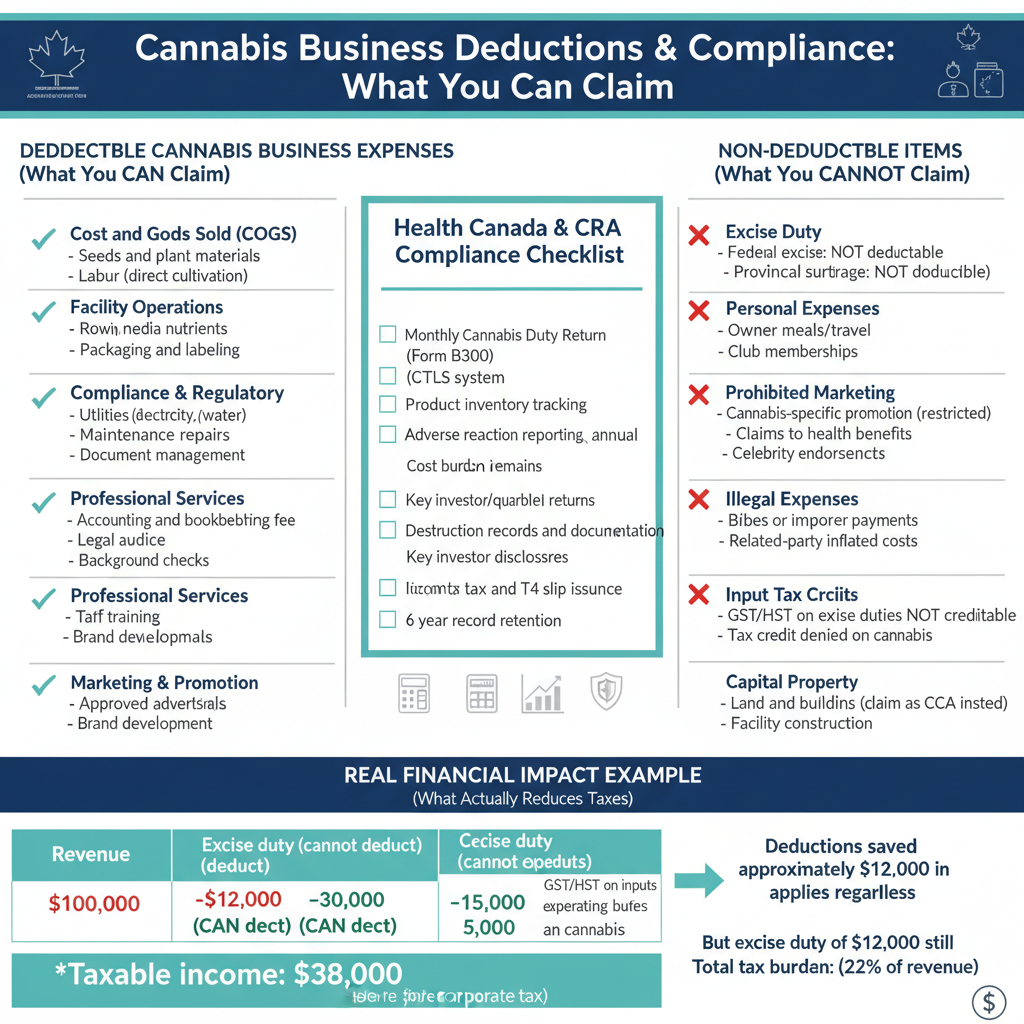
The core challenge: Cannabis businesses in Canada are subject to a multi-layered tax regime that creates a “hidden tax” burden unparalleled in other industries. In addition to standard corporate income tax, GST/HST, and payroll taxes, licensed producers must pay federal and provincial excise duties that can consume 25-30% or more of gross revenue. This excise duty burden—combined with strict regulatory compliance costs—has driven significant consolidation in the industry and made profitability elusive for smaller producers.
Yet strategic tax planning and accounting practices can materially improve cannabis business economics. This guide outlines the complete Canadian cannabis tax environment, identifies legitimate deduction opportunities, explains compliance requirements, and provides actionable strategies for minimizing tax burden while staying compliant with CRA and Health Canada regulations.
For cannabis business owners, accountants, and investors, understanding these dynamics is essential for business viability and investment decision-making.

Part 1: The Three-Tier Cannabis Tax System in Canada
Tier 1: Federal Excise Duty on Cannabis Products
What it is: A federal tax levied on packaged cannabis products when delivered to a purchaser (wholesale or retail).
Rate Structure:
The federal excise duty is the greater of:
- Flat rate: $0.25 per gram of cannabis (dried/fresh flower) or per mg of THC (extracts)
- Ad valorem rate: 7.5% of the wholesale selling price
- Whichever is higher applies to that product
Example of Duty Calculation:
- Dried cannabis product: 1 gram
- Selling price: $10.00/gram
- Flat rate duty: $0.25/gram
- Ad valorem duty: 7.5% × $10 = $0.75
- Duty owed: $0.75 (the higher amount)
Critical Components:
- Federal duty is collected by Health Canada’s Cannabis Tracking System (CTS)
- Duty is paid when cannabis is packaged and ready for delivery
- Different rates apply to different product types (dried flower, extracts, seeds, etc.)
Tier 2: Provincial/Territorial Excise Duty Surcharges
What it is: Additional excise duty imposed by each province/territory on top of federal excise duty.
Provincial Rates (2025):
- Alberta: 16.8% additional (on top of federal)
- British Columbia: Variable by product type
- Ontario: 3.9% additional
- Quebec: Variable by product type
- Saskatchewan: 6.45% additional
- Other provinces: Ranges from 0% to 19.3%
Combined Example (Ontario Licensed Producer):
- Selling price per gram: $10.00
- Federal duty (ad valorem): 7.5% = $0.75
- Provincial duty (3.9% additional): $0.39
- Total excise duty: $1.14 per gram (11.4% of selling price before GST/HST)
Provincial Variation Strategy:
Some provinces have deliberately set lower excise surcharges to attract producer investment. Conversely, provinces with higher surcharges (Alberta at 16.8%) create competitive disadvantage for producers in those regions.
Tier 3: GST/HST (Sales Tax)
What it is: Goods and Services Tax (GST) or Harmonized Sales Tax (HST) applied to the retail selling price of cannabis products after excise duties are included.
Rate:
- Federal GST: 5%
- Provincial HST: Varies by province (13-15%)
- HST provinces: GST + HST applies to final retail price
Critical Rule:
GST/HST is calculated on the final retail selling price, including the excise duty. This creates a cascading tax effect—the excise duty itself is subject to GST/HST.
Example (Ontario, 13% HST):
- Retail selling price: $10.00/gram
- Federal excise duty (7.5%): $0.75
- Ontario excise surcharge (3.9%): $0.39
- Subtotal with excise: $11.14
- HST on $11.14 (13%): $1.45
- Final consumer price: $12.59 (26% tax burden)
For Producers:
- Input Tax Credit (ITC) on cannabis is explicitly denied
- Producers cannot claim GST/HST paid on inputs as credits
- This further increases the effective tax burden
Part 2: The Excise Duty Burden: Financial Impact on Cannabis Producers
Why the Excise Tax Model is Problematic for Canadian Producers
The current excise duty system was designed when legal cannabis was expected to cost significantly more than illicit market cannabis (due to compliance, testing, and quality). The premise was that high prices could absorb the tax burden.
Reality in 2025:
- Legal cannabis prices have collapsed as competition increased
- Average legal cannabis price: $6-$8 per gram (down from $12-$15 in 2018-2019)
- Illicit market prices: $4-$6 per gram
- Excise duty on lower prices consumes an even larger percentage of revenue
Financial Example (Producer with $6/gram wholesale cost):
- Wholesale price to retailer: $6.00
- Federal excise duty (10% of $6): $0.60 (flat rate $0.25/gram applies as well, so $0.60 is duty)
- Provincial surcharge (Ontario 3.9%): $0.23
- Total excise duty: $0.83 (13.8% of selling price)
- Producer gross margin after excise: $5.17 (86.2% of selling price)
But the producer still faces:
- Corporate income tax (~26-27% in Ontario on net profit)
- Payroll taxes (CPP, EI, provincial taxes)
- Sales tax audit risk (GST/HST)
- Compliance costs (Health Canada, CRA, provincial licensing)
Net result: A licensed producer with $6/gram wholesale cost typically operates at 5-10% net margins after all taxes and compliance costs. This compares poorly to established industries (pharmaceutical 15-20% net, consumer packaged goods 10-12% net).
The Government’s Acknowledgment of the Problem
In October 2025, a majority of Canadians (52%) supported reducing cannabis excise taxes, acknowledging the burden on legal producers. The federal government has signaled interest in reform, including:
- Transitioning to a single national excise stamp (currently 13 separate provincial/territorial stamps required)
- Capping excise tax at 10% of wholesale price (down from current ad valorem rates reaching 10-15%+)
- Simplifying regulatory compliance (March 2025 Health Canada amendments reduced some administrative burden)
However, as of December 2025, these reforms have not been implemented, leaving producers operating under the current high-tax regime.
Part 3: Tax Deductions and Compliance for Cannabis Businesses
Standard Business Deductions Available to Cannabis Producers
Cannabis businesses can claim standard business deductions under CRA rules, subject to the requirement that expenses are “reasonable” and directly related to earning business income.
Deductible Cannabis Business Expenses:
- Cost of Goods Sold (COGS)
- Seeds and plant materials
- Growing media (soil, nutrients, amendments)
- Fertilizers and pesticides (approved by Health Canada)
- Labour directly involved in cultivation and processing
- Packaging and labeling materials
- Testing and quality assurance costs
- Facility Operations
- Rent or lease costs for growing facilities
- Utilities (electricity, water, heating, cooling)
- Facility maintenance and repairs
- Security systems and monitoring
- Insurance (facility and product liability)
- Compliance and Regulatory
- Health Canada licensing fees
- Compliance consulting fees
- Regulatory advisory services
- Document management and record-keeping systems
- Product testing and certification
- Professional Services
- Accounting and bookkeeping fees
- Legal advice on regulatory compliance
- Tax planning and preparation
- Security clearance and background check fees
- Administrative Expenses
- Office supplies and equipment
- Telecommunications
- Software licenses (compliance, tracking, accounting)
- Staff training and development
- Marketing and Promotion
- Advertising (subject to strict Health Canada restrictions)
- Point-of-sale materials (within regulations)
- Brand development (within legal limitations)
Critical Deduction Limitation: Excise Duty NOT Deductible
Important: The federal excise duty on cannabis is specifically non-deductible under Section 280.1 of the Income Tax Act.
This means:
- Excise duty cannot reduce taxable income
- Cannabis producers must track excise duty separately as a cost of goods sold (but not a deductible expense)
- This further erodes producer profitability
Example:
- Revenue from cannabis sales: $100,000
- Excise duty paid: $12,000 (12% of revenue)
- Cost of production (COGS): $40,000
- Operating expenses: $20,000
- Gross profit before tax: $100,000 – $40,000 – $20,000 = $40,000
- But the $12,000 excise duty does NOT reduce this $40,000 taxable profit
- Net taxable income: $40,000
- Corporate tax (26%): $10,400
- Total tax burden: $12,000 (excise) + $10,400 (income tax) = $22,400 (22.4% of revenue)
Medical Cannabis Deductions for Individual Patients
While cannabis business tax deductions are standard, it’s worth noting that medical cannabis purchases by individual patients can be claimed as eligible medical expenses if:
- Cannabis is purchased from a licensed medical producer
- Prescribed by a physician
- Original receipts are kept
- Total medical expenses exceed 3% of net income
However, this applies to patients, not producers. Producers cannot claim their inventory as medical expenses.
Part 4: Accounting and Compliance Complexity for Cannabis Operators
Health Canada Compliance Reporting
Cannabis license holders must comply with extensive Health Canada reporting requirements through the Cannabis Tracking and Licensing System (CTLS).
Key Reporting Obligations:
- Monthly Cannabis Duty and Information Return (Form B300)
- Product inventory tracking (by product type, THC content, batch)
- Destruction records (for waste cannabis, cultivation waste)
- Serious adverse reaction reporting (annual summary)
- Key investor disclosures
- Import/export permit tracking
2025 Regulatory Relief:
In March 2025, Health Canada streamlined some requirements:
✓ Eliminated: Requirement to track cultivation waste (leaves, branches, shoots)
✓ Reduced: Frequency of certain reporting obligations
✓ Simplified: Product destruction process (one witness instead of multiple)
✓ Changed: Unit of measurement for seeds (count instead of weight)
These changes reduce compliance burden, but substantial reporting requirements remain.
CRA Tax Compliance for Cannabis Businesses
Cannabis producers must comply with standard CRA tax requirements plus cannabis-specific rules:
- Excise Duty Filing
- Monthly excise duty returns (Form B300)
- Accurate product tracking by THC content
- Documentation of duty paid by province/territory
- Income Tax Compliance
- T1 General (sole proprietor) or T2 (corporation) return
- Schedule 8 (COGS calculation)
- Investment Tax Credit claims (if any green energy investments)
- Capital Cost Allowance (CCA) on facility equipment
- GST/HST Compliance
- Monthly or quarterly GST/HST return
- Input Tax Credits (limited—excise duty is non-creditable)
- Proper documentation of sales and purchases
- Payroll Compliance
- CPP/EI contributions on employee wages
- T4 slip issuance
- Provincial payroll tax deductions
The Accounting Complexity Challenge
For cannabis businesses, the accounting complexity is substantial:
Multi-Track Compliance:
- Health Canada tracking system (CTLS)—product and inventory tracking
- CRA excise duty system—duty calculation and reporting
- CRA income tax system—business income and expenses
- Provincial GST/HST—sales tax management
- Provincial payroll—employee tax withholding
Single error impact: A mismatch between CTLS inventory reports and CRA excise duty returns can trigger audit flags. Underreporting inventory can appear as unreported income or underpaid excise duty.
Recommendation: Cannabis businesses should engage specialized accountants with cannabis industry experience. Generic accounting practices often miss cannabis-specific compliance requirements, creating audit exposure.
Part 5: Strategic Tax Planning for Cannabis Producers
Strategy 1: Business Structure Optimization
Corporation vs. Sole Proprietorship:
For cannabis businesses, incorporation is virtually always preferable because:
- Liability Protection: Cannabis operations carry significant regulatory and product liability risk. Corporation limits personal exposure.
- Tax Rate Optimization: Corporate tax rates (26-27%) are often lower than top personal marginal rates (43-53%), especially for high-income producers.
- Income Splitting (via holding company): Complex, but can allow family members to receive dividends at lower personal tax rates.
- Credibility: Licensed producers are typically required to be incorporated.
Strategy 2: Expense Optimization and Cost Management
While excise duty cannot be reduced through deductions, operational expenses can be carefully managed:
- Facility efficiency: Invest in LED lighting and climate control optimization to reduce electricity costs (often 30-40% of COGS)
- Vertical integration: Self-producing inputs (growing media, nutrients, etc.) rather than purchasing externally
- Bulk purchasing: Negotiate volume discounts on approved fertilizers and materials
- Regulatory compliance technology: Invest in automated CTLS and CRA reporting systems (one-time cost, not ongoing)
Strategy 3: Capacity Utilization and Pricing
Cannabis producers often operate at less-than-full capacity due to market saturation. Marginal pricing analysis is critical:
- Fixed costs (facility, security, management): Occur regardless of production volume
- Variable costs (materials, labor, utilities): Scale with production
- Break-even calculation: Determine the minimum selling price needed to cover fixed + variable costs
Many producers discover that operating at higher capacity (even at lower per-unit margins) is more profitable than operating at lower capacity.
Strategy 4: Diversification by Product Type
Different cannabis product types have different tax and margin profiles:
| Product Type | THC Content | Excise Duty Basis | Typical Margin Impact |
|---|---|---|---|
| Dried Flower | Variable | Per gram (flat) or ad valorem | Standard (~5-8% net) |
| Extracts | Concentrated | Per mg THC | Higher concentration, lower volume |
| Edibles | Variable | Per mg THC | Subject to food safety limits |
| Topicals | Low/None | Per mg THC (if any) | Variable, regulatory constraints |
Strategic opportunity: Products with lower THC content face lower excise duty. Low-THC products (<0.3% THC) are entirely exempt from excise duty.
Part 6: Compliance Pitfalls and Audit Risks
Common CRA Audit Triggers for Cannabis Businesses
- Mismatch between CTLS inventory and tax records
- CRA cross-references Health Canada CTLS data with tax returns
- Inventory discrepancies can trigger audit
- Underreported revenue
- Sales not properly documented
- “Off-books” transactions
- Fails to reconcile with excise duty returns
- Excessive expense claims
- Promotional expenses in violation of Health Canada rules (non-deductible)
- Personal expenses mixed with business expenses
- Related-party transactions at inflated prices
- GST/HST complications
- Improper application of GST/HST to excise duty
- Failure to file GST/HST returns timely
- Input Tax Credit claims on non-creditable items
Compliance Best Practices
- Real-time tracking: Use CTLS-integrated software to track inventory continuously (don’t rely on year-end reconciliation)
- Separate accounts: Maintain completely separate accounting for excise duty, tax deductions, and GST/HST
- Documentation: Keep detailed records of all Health Canada compliance activities (testing, adverse reactions, promotion)
- Third-party verification: Engage accountants and lawyers regularly, not just at year-end
- Conservative approach: When uncertain, err on side of reporting higher income/lower deductions (easier to claim refund than defend audit position)
Part 7: 2025-2026 Outlook: Regulatory and Tax Changes
Anticipated Reforms
As of December 2025, the cannabis industry is awaiting potential reforms that could materially improve business economics:
Proposed federal excise tax reforms:
- Single national excise stamp (vs. current 13 separate stamps)
- Cap excise tax at 10% of wholesale price
- Expand low-THC exemption thresholds
- Streamline compliance reporting further
Timeline: These reforms are in discussion stage and could be implemented in 2026-2027 if political will aligns.
Monitoring Requirements
Cannabis business owners should monitor:
- Federal budget announcements (typically April/May each year)
- Health Canada regulatory updates (published in Canadian Gazette)
- Provincial/territorial excise duty changes (vary by province, announced irregularly)
- CRA guidance on cannabis-specific tax issues
Conclusion: Building Sustainable Cannabis Business Economics
The Canadian cannabis industry in 2025 faces a profitability challenge rooted in the excise duty system. Yet through strategic tax planning, careful compliance management, and operational optimization, cannabis producers can improve economics and build sustainable businesses.
The key is to view taxes and compliance not as inevitable burdens, but as manageable costs that can be optimized through:
- Proper business structuring (incorporation)
- Careful expense management and operational efficiency
- Strategic product mix and pricing analysis
- Meticulous compliance documentation to avoid audit exposure
- Regular engagement with cannabis-specialized accountants
As regulatory reforms potentially arrive in 2026-2027, producers who optimize their current operations will be positioned to scale efficiently when tax burden decreases.
For accountants and advisors serving the cannabis industry, specialization in cannabis-specific tax and compliance rules is essential. The intersection of Health Canada regulations, CRA excise duty rules, and standard income tax compliance creates a unique challenge that requires depth of knowledge.
Article created for BOMCAS Canada. For cannabis industry accounting, tax planning, and compliance guidance, contact info@bomcas.ca








 View Our Location





 181 Meadowview Bay, Sherwood Park, AB T8H 1P7, Canada (Online Clients Only)