



Executive Summary
Canada’s approach to cryptocurrency taxation has become increasingly sophisticated, with the Canada Revenue Agency (CRA) now using advanced blockchain analytics to track crypto transactions across all major exchanges and networks. Yet most Canadian crypto investors remain confused about fundamental questions: Are my trades capital gains or business income? How do I calculate my adjusted cost base? What’s taxable when I stake or mine? How did the June 2024 capital gains inclusion rate change affect my taxes?
The stakes are high. Misclassifying $10,000 in gains as capital instead of business income could save you $2,500 in taxes—or cost you $2,500 in penalties if the CRA audits you. Forgetting to report staking rewards worth $5,000 could trigger a full compliance review of your crypto transactions going back six years.
This comprehensive guide explains how the CRA treats every type of crypto transaction, walks you through the calculation of adjusted cost base and capital gains, clarifies the critical June 25, 2024 inclusion rate change, explains NFT taxation, mining and staking income treatment, and shows you exactly which forms to use when filing your personal tax return.
For Canadian crypto investors, understanding these rules is the difference between claiming optimal tax treatment and facing audits, penalties, and interest charges.

Part 1: Crypto is Property, Not Currency—How the CRA Classifies Assets
Foundational Rule: The CRA Treats Crypto as Commodity Property
What This Means:
- Cryptocurrency is NOT treated as currency (like USD or EUR)
- Cryptocurrency IS treated as a commodity (like gold, oil, or stocks)
- Every transaction involving crypto is a potential taxable event
- Every transaction requires documentation and calculation of gain/loss
Consequences:
- Buying crypto: NOT taxable (establishing position)
- Holding crypto: NOT taxable (no transaction)
- Selling crypto: TAXABLE (disposition—gain or loss calculated)
- Trading crypto for crypto: TAXABLE (disposition of first asset + acquisition of second)
- Using crypto to buy goods: TAXABLE (disposition)
- Receiving crypto as income: TAXABLE (as income, not capital gains)
Two Tax Regimes: Capital Gains vs. Business Income
The fundamental question for every crypto transaction is: Will this be taxed as a capital gain or business income?
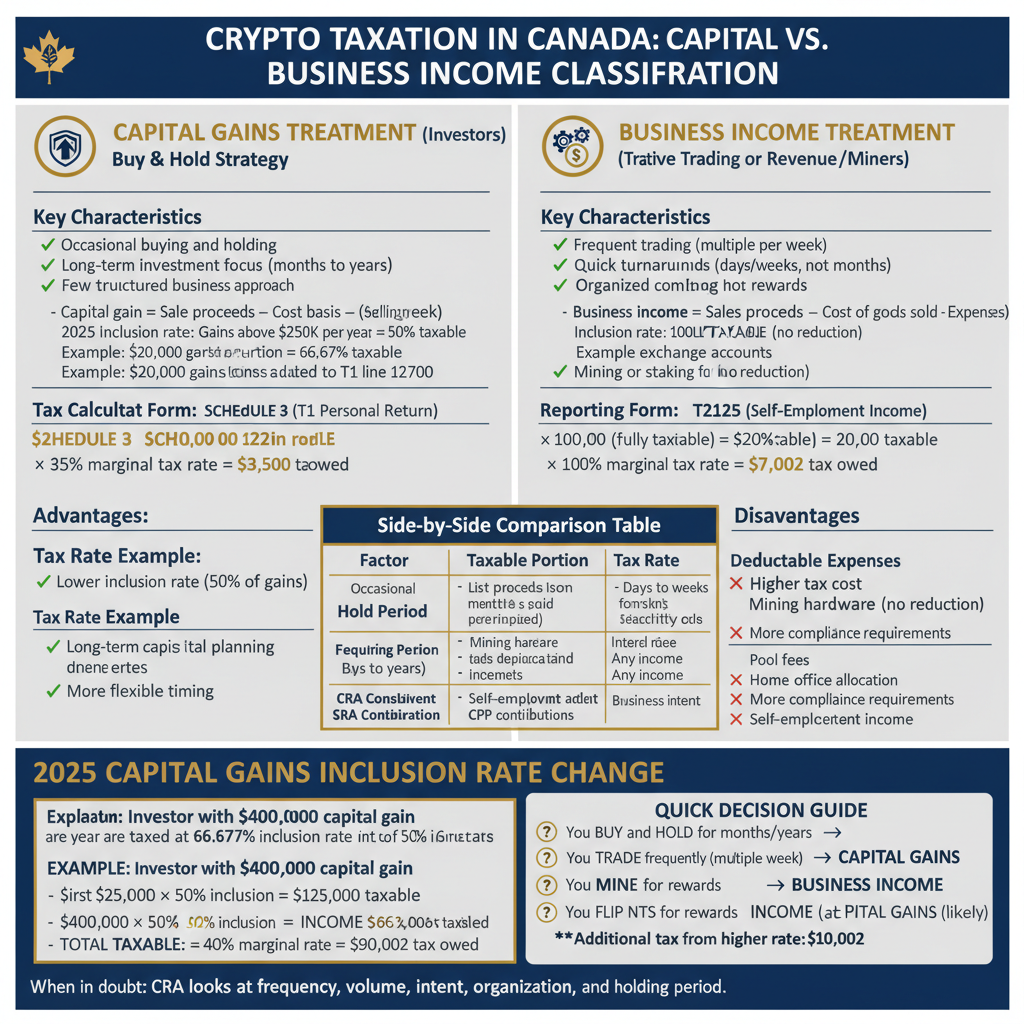
Capital Gains Treatment (For Investors):
- Applies when: You buy and hold crypto, or occasionally sell for appreciation
- Taxation: Only 50% of capital gains are taxable (through $250K annually; above that 66.67%)
- Reporting: Schedule 3 of T1 personal tax return
- Example: $1,000 profit × 50% inclusion = $500 added to taxable income
- Cost basis: Adjusted Cost Base (ACB) method
- Losses: Can only offset other capital gains (not regular income)
Business Income Treatment (For Traders, Miners, Stakers):
- Applies when: You frequently trade, mine, stake, or NFT flip
- Taxation: 100% of business income is fully taxable
- Reporting: T2125 (Statement of Self-Employment Income)
- Example: $1,000 profit = $1,000 added to taxable income (no reduction)
- Cost basis: Cost of goods sold method
- Deductions: Full deduction of operating expenses
- Losses: Can offset any income (not limited to capital gains)
The CRA’s Test: When Is It Business Income?
The CRA considers multiple factors:
- Frequency of trading (occasional vs. constant)
- Volume of transactions (small amounts vs. large volumes)
- Time period (quick flips vs. long holds)
- Commercial organization (structured business vs. casual activity)
- Use of leverage or complex strategies
- Multiple platforms or trading accounts
- Intention to profit (primary motivation)
Important: The CRA looks at substance over form. Just because you call it “investing” doesn’t mean the CRA will treat it that way if your behavior resembles trading.
Part 2: The Capital Gains Inclusion Rate Change—June 25, 2024 (Critical!)
What Changed and When
Before June 25, 2024:
- Individuals: 50% of all capital gains were taxable
- Corporations and trusts: 50% of all capital gains were taxable
On and After June 25, 2024:
- Individuals:
- First $250,000 per year: 50% inclusion rate (unchanged)
- Gains exceeding $250,000: 66.67% inclusion rate (increased)
- Threshold applies annually (does NOT carry forward or aggregate)
- Corporations & Trusts:
- 66.67% inclusion rate on ALL capital gains (no exemption)
What This Means for Crypto Investors
Example 1: Modest Crypto Investor (2024)
- Capital gain: $20,000
- Taxable portion: $20,000 × 50% = $10,000
- At 35% marginal rate: $3,500 in tax
Example 2: Large Crypto Seller (2024, Before June 25)
- Capital gain: $500,000
- Taxable portion: $500,000 × 50% = $250,000
- At 35% marginal rate: $87,500 in tax
Example 3: Large Crypto Seller (2024, After June 25)
- Capital gain: $500,000
- Taxable portion:
- First $250,000 × 50% = $125,000
- Remaining $250,000 × 66.67% = $166,675
- Total taxable: $291,675
- At 35% marginal rate: $102,086 in tax
- Additional tax cost: $14,586 (16.7% increase)
Lifetime Capital Gains Exemption (Increased to $1,250,000)
New Exemption Amount (as of June 25, 2024):
- Increased from $1,016,836 to $1,250,000
- Applies to dispositions on or after June 25, 2024
- Applies to: Qualified small business shares, farm/fishing property
- Does NOT apply to: Investment crypto holdings (only business-owned crypto might qualify)
- Future indexation: Resumes in 2026 (indexed annually)
Part 3: How to Calculate Crypto Capital Gains and Losses
Step 1: Calculate Your Adjusted Cost Base (ACB)
What is ACB?
Your adjusted cost base is the original price you paid for the crypto, plus all related costs associated with acquiring it.
Includes:
- Purchase price in Canadian dollars
- Trading fees
- Gas fees (blockchain transaction fees)
- Marketplace charges
- Any other fees directly related to acquisition
Does NOT Include:
- General investment advisory fees
- Tax professional fees
- Software subscription fees
Example: Bitcoin Purchase
- Buy 1 BTC at: $50,000
- Trading fee: $100
- Gas fee: $50
- Total ACB: $50,150
Cost Basis Methods:
The CRA accepts two methods:
- Average Cost Method: Average price per unit across all holdings
- First-In-First-Out (FIFO): Sell oldest units first
Choose one method and use it consistently across all years.
Step 2: Determine Proceeds of Disposition
Proceeds of Disposition = The fair market value (FMV) of what you received when you disposed of the crypto.
Examples:
- Selling for fiat: $50,000 CAD proceeds
- Trading for another crypto: FMV of received crypto (in CAD) is proceeds
- Using to buy goods: FMV of goods received (in CAD) is proceeds
Fair Market Value (FMV):
- The price the crypto was trading at on the transaction date
- Use exchange rates at time of sale (not average for the month)
- Document with screenshots, exchange records, or price history services
- CoinMarketCap, CoinGecko, or exchange records acceptable
Step 3: Calculate Capital Gain or Loss
Formula:
Capital Gain (or Loss) = Proceeds of Disposition − Adjusted Cost Base − Selling Costs

If result > 0: You have a capital GAIN
If result < 0: You have a capital LOSS
Example: Bitcoin Sale
- Proceeds of disposition (sale price): $52,000
- Adjusted cost base: $50,150
- Selling fee: $50
- Capital gain = $52,000 − $50,150 − $50 = $1,800
- Taxable capital gain: $1,800 × 50% = $900 (assuming gain < $250K)
Step 4: Apply the Inclusion Rate (Capital Gains Calculation)
For 2025 and Beyond (Individuals):
- Capital gains up to $250,000 per year: 50% inclusion rate
- Capital gains exceeding $250,000 per year: 66.67% inclusion rate
Calculation:
- Net your total capital gains and losses for the year
- Determine if your net gains exceed $250,000
- Apply appropriate inclusion rate
Example: Canadian Investor with $300,000 Net Capital Gain (2025)
- Gains from $0–$250,000: $250,000 × 50% = $125,000 taxable
- Gains from $250,001–$300,000: $50,000 × 66.67% = $33,335 taxable
- Total taxable capital gain: $158,335
- At 40% marginal rate: $63,334 in tax
Step 5: Capital Loss Carryback and Carryforward
How Capital Losses Work:
- Capital losses can ONLY offset capital gains (not regular income)
- Can carry losses back 3 years
- Can carry losses forward indefinitely
- Unused losses from previous years can offset current gains
Example:
- 2023 capital loss: $10,000 (unused)
- 2025 capital gain: $30,000
- 2025 taxable capital gain: ($30,000 − $10,000) × 50% = $10,000
Part 4: Taxable Events in Crypto—Every Transaction That Triggers Tax
Taxable Events (Disposition = Gain/Loss Calculation Required)
1. Selling Crypto for Fiat Currency (CAD, USD, etc.)
- Creates a disposition
- Taxable event occurs at moment of sale
- Use Canadian dollar amount at time of sale
- Example: Sell 1 BTC for $52,000 CAD on May 15, 2025
2. Trading One Crypto for Another (Crypto-to-Crypto Trades)
- Both assets involved create a taxable event
- You’re disposing of the first crypto (calculate gain/loss)
- You’re acquiring the second crypto (FMV becomes new ACB)
- Example: Trade 1 BTC for 20 ETH
- Bitcoin: Dispose at FMV of ETH received in CAD
- Ethereum: Acquire at same FMV in CAD
3. Using Crypto to Purchase Goods or Services
- Crypto disposition occurs
- Calculate gain/loss based on FMV of goods received
- You have a tax liability even if no fiat currency involved
- Example: Pay $10,000 in Bitcoin for a car worth $40,000
- Bitcoin disposed at $40,000 FMV
- Potential large capital gain
4. Mining Rewards (NEW CRYPTO CREATED)
- Taxable as INCOME (not capital gains) when received
- Amount: Fair market value of tokens at receipt date
- Becomes cost basis for future disposition
- Fully deductible mining expenses
- Reported on T2125 (self-employment)
5. Staking Rewards (CRYPTO LOCKED UP TO EARN REWARDS)
- Taxable as INCOME (not capital gains) when received
- Amount: Fair market value of reward tokens in CAD at receipt date
- Becomes cost basis for future disposition
- Example: Receive 10 Cardano @ $0.50 = $5 income to report
- Reported on T1 (as income from property)
6. Airdrops (FREE TOKENS FROM BLOCKCHAIN PROJECT)
- Taxable as INCOME if tied to a project/activity
- Not taxable if airdrop is pure gift unrelated to blockchain participation
- Fair market value in CAD at receipt date
- Documentation important (project eligibility, date received)
7. Hard Forks (NEW COINS CREATED FROM BLOCKCHAIN SPLIT)
- Taxable as INCOME when coins become available
- Fair market value in CAD at availability date
- Example: Bitcoin hard fork creates Bitcoin Cash
- If you hold BTC, you automatically receive BCH
- BCH becomes taxable income at FMV on fork date
8. DeFi Liquidity Mining / Yield Farming (PLATFORM REWARDS)
- Taxable as INCOME when received
- Fair market value of reward tokens in CAD
- Tokens received become inventory (if sold = business income)
NON-Taxable Events (No Gain/Loss Calculation Required)
1. Buying Crypto (Establishing Position)
- NOT taxable when you buy
- Only establishes your cost basis
- Tax applies only when you dispose
2. Holding Crypto (No Sales)
- NOT taxable
- No matter how much the price increases
- Only taxed when you sell, trade, or use
3. Transferring Between Your Own Wallets
- NOT taxable (no change of ownership)
- Moving from exchange wallet to self-custody wallet: NOT taxable
- Moving between your personal wallets: NOT taxable
4. Gifting Crypto to Family
- NOT taxable to recipient
- IS taxable to giver (disposition at FMV)
- Example: Gift 1 BTC worth $50,000 to son
- You have a disposition at $50,000 FMV
- Son has no tax on receipt
- When son sells, his cost basis is $50,000
Part 5: NFT Taxation—Specific Rules for Digital Assets
NFT Classification: Investor vs. Flipper vs. Creator
The tax treatment of NFTs depends entirely on how you use them:
NFT as Investment (Capital Gains)
- You buy NFTs for long-term appreciation
- You hold for months or years
- You occasionally sell
- Tax treatment: Capital gains (50% inclusion for gains up to $250K)
- Example: Buy NFT for $10,000, sell for $15,000 one year later
- Capital gain: $5,000
- Taxable capital gain: $5,000 × 50% = $2,500
NFT as Flipping (Business Income)
- You buy and quickly resell for profit
- You trade frequently across multiple platforms
- Quick turnarounds (days/weeks, not months/years)
- Tax treatment: Business income (100% taxable)
- Example: Buy NFT for $5,000, flip for $8,000 three days later
- Business income: $3,000 (fully taxable)
- If you do this regularly, all NFT activity becomes business income
NFT as Creator (Business Income)
- You mint and sell original NFTs
- You earn royalties on secondary sales
- You curate and sell collections
- Tax treatment: Business income (100% taxable)
- Deductible: Creation costs, platform fees, marketing
Crypto-to-NFT Purchases = Double Taxable Event
When You Buy an NFT with Cryptocurrency:
Two separate taxable events occur:
Event 1: Crypto Disposition
- You dispose of the crypto you used
- Calculate capital gain on the crypto
- Example: Use 1 ETH (cost $3,000) to buy NFT worth $5,000
- ETH is disposed at $5,000 FMV
- Capital gain on ETH: $5,000 − $3,000 = $2,000
Event 2: NFT Acquisition
- The NFT becomes an asset with cost basis = FMV paid
- Example: NFT cost basis = $5,000 (the ETH FMV)
- Future sale profit calculated from this $5,000 base
Total Tax Impact:
- Crypto gain taxed at receipt (50% inclusion for capital)
- NFT gain taxed on future sale (50% or 100% depending on use)
Reporting NFT Transactions
On Schedule 3 (Capital Gains):
- Cost basis of NFT (in CAD)
- Proceeds of sale (in CAD)
- Capital gain or loss
- Cryptocurrency used to purchase (if applicable)
On T2125 (Business Income, if applicable):
- Gross proceeds from NFT sales
- Basis and operating costs
- Net business income
Part 6: Mining and Staking Rewards—Income, Not Capital Gains
Cryptocurrency Mining
Definition:
Mining is the process of validating blockchain transactions and creating new cryptocurrency tokens as a reward.
Tax Treatment:
- Mining income is ALWAYS treated as business income (100% taxable)
- NOT capital gains treatment
- Reported on T2125 (self-employment)
Taxable Amount:
- Fair market value of tokens when mined (in Canadian dollars)
- Value determined on date block is mined/reward becomes available
Example: Bitcoin Mining
- Mine 1 BTC block reward on June 1, 2025
- BTC trading at $52,000 on June 1, 2025
- Taxable mining income: $52,000
Deductible Expenses:
- Mining hardware and equipment costs
- Depreciation on equipment (CCA)
- Electricity costs
- Cooling and ventilation systems
- Space rental or home office allocation
- Internet costs
- Software and pool fees
- Maintenance and repairs
- Insurance on equipment
When Mining Might Be Business vs. Hobby:
- One GPU: Could be hobby (not all deductible)
- Multiple rigs: Business activity (full deductions allowed)
- Regular scheduling: Business activity
- Keeping records: Business activity
- Advertising mining: Business activity
Staking Rewards
Definition:
Staking is when you lock cryptocurrency to secure a blockchain and earn reward tokens in return.
Tax Treatment:
- Staking rewards are taxed as INCOME (not capital gains)
- Taxable when you RECEIVE the rewards (not when you sell)
- Reported on T1 as income from property
Taxable Amount:
- Fair market value of reward tokens in Canadian dollars
- Value determined on date you receive the rewards
Example: Ethereum Staking
- Stake 10 ETH on Lido on January 15, 2025
- Receive 0.5 stETH reward on January 30, 2025
- stETH trading at $2,000 on January 30
- Taxable staking income: 0.5 × $2,000 = $1,000
Cost Basis for Future Sales:
- The FMV of reward tokens becomes your cost basis
- Example continued:
- You receive stETH with $1,000 cost basis
- Later sell for $1,200
- Capital gain: $200
Staking as Business Activity:
When staking becomes a business:
- Run a validator node
- Operate a staking pool
- Provide staking services to clients
In these cases:
- All staking rewards are business income (T2125)
- Can deduct operating expenses (servers, electricity, etc.)
Airdrops
Tax Treatment:
- Taxable as INCOME when received (if tied to project/activity)
- Fair market value in Canadian dollars
- Cost basis for future disposition
When Taxable:
- If airdrop requires participation or previous holdings: TAXABLE
- If pure unsolicited gift unrelated to blockchain: Possibly NOT taxable
Example: Uniswap Airdrop
- You hold ETH and become eligible for UNI airdrop
- Receive 400 UNI tokens worth $1,600
- Taxable airdrop income: $1,600
Part 7: How to Report Crypto Taxes on Your T1 Personal Tax Return
Where to Report: Schedule 3 (Capital Gains/Losses)
For Individual Investors (Capital Gains Treatment):
You report crypto gains and losses on Schedule 3 – Capital Gains or Losses attached to your T1 personal income tax return.
Information Required:
- Description of property (e.g., “Bitcoin,” “Ethereum,” “NFT collection”)
- Date acquired
- Date disposed
- Proceeds of disposition (in Canadian dollars)
- Adjusted cost base
- Capital gain or loss
- Net capital gain for the year
How to Calculate Section of Schedule 3:
- List each crypto disposition separately (or group by type)
- Calculate capital gain/loss for each
- Add all gains and losses
- Net gains minus net losses = Net capital gain for year
- Apply inclusion rate (50% for first $250K, 66.67% thereafter)
- Result goes to line 12700 of T1 (Capital gains)
Where to Report: T2125 (Self-Employment Income)
For Active Traders, Miners, Stakers (Business Income Treatment):
You report crypto business income on Form T2125 – Statement of Business or Professional Activities.
Information Required:
- Gross income from crypto sales/trades
- Less: Cost of goods sold (adjusted cost base)
- Less: Operating expenses (deductible costs)
- Net business income
- Self-employment tax (CPP contributions)
T2125 Sections:
- Part A: Business identification and address
- Part B: Income and expenses summary
- Part C: Detailed expenses (depreciation, vehicle, etc.)
Where to Report: T1135 (Foreign Property Reporting)
If you hold crypto on foreign platforms:
- Holding cryptocurrency on foreign exchange (Kraken, Coinbase, Binance, etc.)
- Total cost exceeds $100,000 CAD
- Must file Form T1135 – Foreign Income Verification Statement
Why It Matters:
- CRA uses T1135 to track foreign crypto holdings
- Non-filing can trigger full audit
- Failure to report is serious non-compliance
Where to Report: T776 (Rental Income, If Applicable)
If you earn staking rewards as property income:
- Some staking arrangements could be reported on T776
- Generally T1 (income from property) is sufficient
- Consult tax professional for complex arrangements
Part 8: Documentation and Record-Keeping Requirements
What Records You Must Keep
The CRA requires detailed documentation for ALL crypto transactions:
For Every Transaction, Keep:
- Transaction date (exact date and time preferred)
- Amount of crypto involved
- Fair market value in Canadian dollars (exchange rate on transaction date)
- Type of transaction (purchase, sale, trade, mining, staking, etc.)
- Purpose of transaction (investment, trading, business)
- Counterparty information (exchange name, wallet address if applicable)
- Fees paid (transaction fees, gas fees, marketplace fees)
- Screenshots or transaction receipts from exchange
Example Record for Bitcoin Sale:
- Date: May 15, 2025, 2:45 PM ET
- Asset: Bitcoin (BTC)
- Quantity: 0.5 BTC
- Sale price per unit: $52,000 CAD
- Total proceeds: $26,000 CAD
- Selling fee: $50 CAD
- Net proceeds: $25,950 CAD
- Cost basis: $25,000 CAD
- Capital gain: $950 CAD
- Screenshot: Kraken exchange confirmation
- Documentation: Saved PDF receipt from Kraken
Storage of Records
Retention Period:
- Keep records for MINIMUM 6 years
- CRA can audit back 6 years as standard
- Can extend audit period if non-compliance suspected
- Recommendation: Keep indefinitely if space permits
Where to Store:
- Digital: Encrypted files, cloud storage (Google Drive, OneDrive, etc.)
- Physical: Binders, file folders
- Tax software: Many crypto tax software store records automatically
- Spreadsheet: Organized Excel/Google Sheets with all transactions
Tax Software and Tools
Crypto Tax Software (Automated):
- CrypTax, Koinly, CoinLedger, Cryptact
- Connects to exchanges automatically
- Calculates ACB, capital gains, reports to CRA forms
- Costs $30–$300 per year
- Highly recommended for active traders
Manual Tracking:
- Spreadsheet (Excel, Google Sheets)
- Enter date, amount, FMV, gain/loss for each transaction
- Calculate totals manually
- More time-consuming but free
- Works for investors with fewer transactions (<20/year)
Part 9: Step-by-Step Examples
Example 1: Simple Bitcoin Investor (Capital Gains)
Scenario:
- Buy 0.5 BTC on January 5, 2024, at $42,000 CAD per BTC
- Hold throughout 2024
- Sell 0.5 BTC on September 10, 2024, at $48,000 CAD per BTC
- Pay $75 in trading fees on sale
Calculation:
- Cost basis: 0.5 × $42,000 = $21,000
- Proceeds: 0.5 × $48,000 = $24,000
- Less: Selling fee = $75
- Capital gain: $24,000 − $21,000 − $75 = $2,925
Tax Report (Schedule 3):
- Proceeds of disposition: $24,000
- Adjusted cost base: $21,000
- Capital gain: $2,925
- Taxable capital gain (50% inclusion): $1,462.50
- Added to line 12700 of T1
- At 35% marginal rate: $512 in tax owed
Example 2: Frequent Trader (Business Income)
Scenario:
- 50+ crypto trades throughout 2024
- Average hold period: 2–3 weeks per position
- Buys on Binance, sells on Kraken, trades back and forth
- Total gross proceeds from sales: $150,000
- Total cost of goods sold: $135,000
- Operating expenses: $2,000 (software, internet, fees)
Calculation:
- Gross proceeds: $150,000
- Less: Cost of goods sold: $135,000
- Gross profit: $15,000
- Less: Operating expenses: $2,000
- Net business income: $13,000
Tax Report (T2125):
- Business income: $13,000 (fully taxable, no 50% reduction)
- At 35% marginal rate: $4,550 in tax owed
- Plus: CPP self-employment contributions (~9.9% of income)
Example 3: Mining Operation (Business Income)
Scenario:
- Mine Bitcoin throughout 2024
- Mine 2 BTC total (block rewards and pool payouts)
- Average mining price: $45,000 per BTC
- Mining expenses:
- Hardware (depreciation): $5,000
- Electricity: $12,000
- Pool fees: $800
- Home office allocation: $2,000
Calculation:
- Mining income (2 BTC @ $45,000): $90,000
- Less: Hardware depreciation: $5,000
- Less: Electricity: $12,000
- Less: Pool fees: $800
- Less: Home office: $2,000
- Net business income: $70,200
Tax Report (T2125):
- Mining income: $90,000
- Total expenses: $19,800
- Net income: $70,200 (fully taxable)
- At 40% marginal rate: $28,080 in tax owed
- Plus: CPP self-employment contributions (9.9%)
Cost Basis for Mining Rewards:
- Each mined Bitcoin has cost basis of $45,000 (FMV at mining date)
- If later sold for $52,000, capital gain = $7,000 (50% taxable = $3,500)
Example 4: NFT Flipper (Business Income)
Scenario:
- Buy NFT on January 10, 2024, for 5 ETH (cost: $10,000)
- Sell NFT on January 22, 2024, for 7 ETH (value: $14,000)
- Repeat this 30 times throughout the year
- Total profits: $120,000
Calculation:
- All 30 transactions characterized as business income (due to frequency, volume, speed)
- Gross proceeds: $420,000 (30 sales × average $14,000)
- Cost of goods sold: $300,000 (30 purchases × average $10,000)
- Operating expenses (gas fees, platform fees): $5,000
- Net business income: $115,000
Tax Report (T2125):
- Business income: $115,000 (fully taxable)
- At 40% marginal rate: $46,000 in tax owed
Alternative: NFT Investor (One-Time Sale)
- If same person buys one NFT for $10,000 and sells for $14,000 after two years
- Capital gains treatment: $4,000 × 50% = $2,000 taxable
- At 40% marginal rate: $800 in tax owed
- Difference: $45,200 in taxes based on classification alone
Example 5: Capital Gains Above $250,000 Threshold (2024)
Scenario:
- Investor sells multiple crypto positions in December 2024
- Total capital gains: $400,000
- No capital losses to offset
Calculation:
- Gains from $0–$250,000: $250,000 × 50% inclusion = $125,000 taxable
- Gains from $250,001–$400,000: $150,000 × 66.67% inclusion = $100,005 taxable
- Total taxable capital gain: $225,005
- At 40% marginal rate: $90,002 in tax owed
Comparison: If all gains had 50% inclusion:
- $400,000 × 50% = $200,000 taxable
- At 40% rate: $80,000 in tax
- Additional tax from higher rate: $10,002
Part 10: Common CRA Audit Triggers and Compliance Issues
Red Flags That Trigger Crypto Audits
The CRA uses automated systems and blockchain analytics to identify non-compliance:
Documentation Red Flags:
- No record-keeping system documented
- Gaps in transaction reporting
- Inconsistent cost basis calculations
- Missing transaction receipts or screenshots
- Inability to support reported gains/losses
Transaction Red Flags:
- Frequent large transfers to exchanges
- Rapid buy-sell cycles (day trading not reported as business)
- High-value transactions with no corresponding tax reporting
- Unreported mining or staking activity
- Foreign exchange accounts not reported on T1135
Lifestyle Red Flags:
- Income doesn’t match spending/lifestyle
- Large cryptocurrency holdings with minimal reported income
- Recent business startup with immediate large gains
- Luxury purchases correlating with crypto activity
Pattern Red Flags:
- Repeated use of average cost vs. FIFO method
- Frequent capital losses offsetting other income
- Selective reporting of losses but not gains
- Unexplained changes in trading patterns year to year
CRA’s Blockchain Analytics Capabilities
What CRA Can Track:
- Public blockchain transactions (Bitcoin, Ethereum, etc.)
- Wallet-to-exchange transfers
- Exchange transaction records (Canadian exchanges report to CRA)
- Large transaction reporting from banks
- SWIFT transfers to crypto exchanges
- Deposit and withdrawal patterns
As of 2026:
- Canadian crypto platforms required to report transaction data to CRA
- Account holder information sharing with CRA
- Cross-border transaction reporting
- Real-time compliance monitoring expected
Voluntary Disclosure Program (VDP)
If You Missed Reporting Crypto:
- File under Voluntary Disclosure Program before CRA contacts you
- Eliminates penalties (saves 25% on tax owed)
- Reduces interest charges
- Provides certainty and closure
- Works for: Unreported mining, staking, DeFi rewards, missing trades
Process:
- Contact CRA or tax professional
- Disclose all unreported crypto activity
- File amended returns with correct reporting
- CRA assesses based on guidelines
- Penalties waived, interest reduced
Cost-Benefit:
- If owed $10,000 in taxes + $2,500 penalties
- VDP: Pay $10,000 in tax + reduced interest (no penalties)
- Saves: $2,500 in penalties
Part 11: Key Tax Dates and Deadlines 2025-2026
| Date | Event |
|---|---|
| December 31, 2025 | Last day of 2025 tax year |
| January 2026 | CRA begins publishing NFT and crypto compliance guidance updates |
| March 1, 2026 | CRA’s January 15 deadline for brokers to file electronic data |
| June 15, 2026 | If self-employed: deadline to file 2025 tax return |
| April 30, 2026 | If not self-employed: deadline to file 2025 tax return |
| Ongoing 2026 | New crypto platform reporting requirements take effect |
Conclusion: Crypto Tax Compliance is Non-Negotiable
Cryptocurrency taxation in Canada has moved beyond the “wild west” era. The CRA now:
- Tracks blockchain transactions in real-time
- Requires platform reporting (effective 2026)
- Uses blockchain analytics to identify non-compliance
- Conducts audits with sophisticated technology
- Issues significant penalties for missed reporting
Your choices are clear:
- Full Compliance: Report all transactions accurately, keep detailed records, pay required taxes
- Voluntary Disclosure: If you missed reporting, file under VDP before CRA contacts you
- Non-Compliance Risk: Face audits, penalties (25% of tax owed), interest charges, and possible criminal referral
For Canadian crypto investors, understanding these rules—and applying them consistently—is the only path to long-term financial security. The tax cost of non-compliance far exceeds the tax cost of proper reporting.
Start today: Set up a record-keeping system, gather your transaction history, and calculate your 2024-2025 gains properly. Your future self will thank you.
Article created for BOMCAS Canada. For crypto tax planning and compliance help, contact info@bomcas.ca









 View Our Location





 181 Meadowview Bay, Sherwood Park, AB T8H 1P7, Canada (Online Clients Only)