



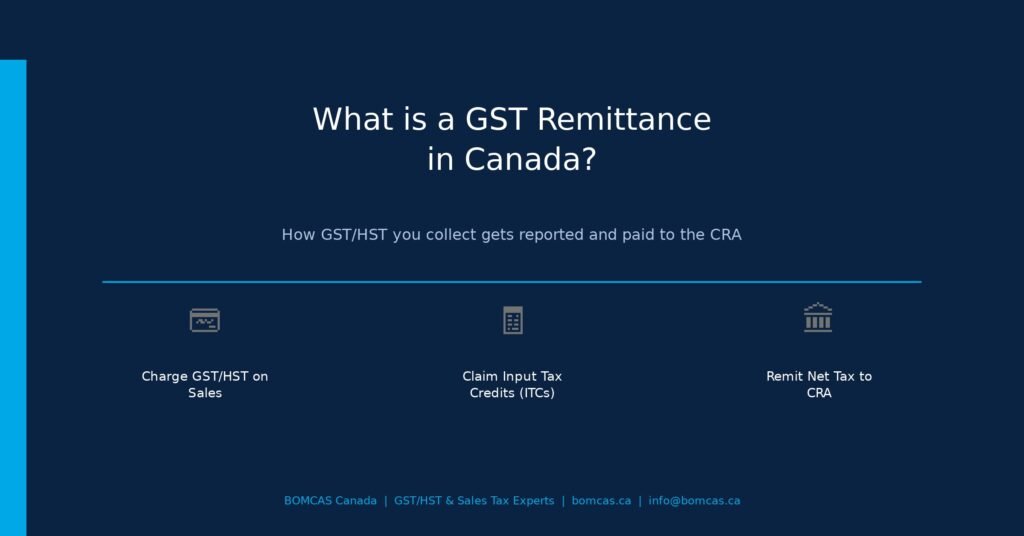
A GST remittance in Canada is the process of reporting and paying to the Canada Revenue Agency (CRA) the net Goods and Services Tax (GST) or Harmonized Sales Tax (HST) your business has collected from customers, after subtracting any eligible input tax credits (ITCs) on your business expenses. In practical terms, your business collects GST/HST on taxable sales, claims credits for GST/HST paid on inputs, and then sends the net amount owing to CRA by your filing due date.
What GST Remittance Means
In tax and accounting, “to remit” means to send or pay money owed to a government authority. For GST/HST, this refers to forwarding the sales tax you’ve collected from customers (minus credits for GST/HST you paid on eligible business expenses) to the CRA. Your business is effectively acting as a tax collector on the government’s behalf, so those funds are never really your income.
When you remit GST/HST, you are settling the balance of tax for a reporting period based on your GST/HST return, not just making a random payment. This is why accurate records and proper calculation of your net tax are critical.
How GST/HST Works for Businesses
Most goods and services in Canada are subject to either GST (the federal value-added tax) or HST (a combined federal–provincial sales tax used in participating provinces). Once your business is GST/HST-registered (mandatory when your worldwide taxable revenues exceed 30,000 dollars in a 12‑month period, or voluntarily earlier), you must:
- Charge the correct GST or HST rate on taxable sales based on place-of-supply rules.
- Track GST/HST collected from customers separately from your revenue.
- Track GST/HST paid on eligible business expenses so you can claim input tax credits.
At the end of each reporting period (monthly, quarterly, or annually), you calculate your net tax:
Net GST/HST to remit=GST/HST collected on sales−Input tax credits (ITCs) on expenses
This formula is exactly how CRA expects businesses to compute their remittance: GST/HST collected less ITCs equals the amount you send to CRA.
What Is Included in a GST Remittance?
Your GST remittance is based on information reported in your GST/HST return for the period. The key components are:
- Total GST/HST collected on taxable supplies (sales, fees, and other revenues).
- Total GST/HST paid on eligible business expenses and purchases you are claiming as input tax credits.
- Adjustments, such as bad debt adjustments, credit notes, or adjustments for change in use of assets.
- Net tax — the difference between GST/HST collected and ITCs, which can be either:
If you collected less GST/HST than you paid (for example, early-stage or capital-intensive businesses), you may show a net refund position rather than a remittance owing.
GST/HST Filing and Remittance Frequency
Your GST/HST remittance frequency is tied to your assigned reporting period. CRA generally sets this based on your annual taxable revenues, but there is some flexibility to choose more frequent filing. Common frequencies are:
- Monthly: Usually for businesses with higher sales; filing and payment are due one month after the end of each reporting period.
- Quarterly: Filing and payment are due one month after the quarter-end.
- Annual: For some smaller businesses and many individuals with business income; filing/payment rules vary slightly by entity type and year-end.
For example, for quarterly filers:
- Q1 (January 1–March 31) return and payment are due by April 30.
- Monthly and quarterly filers generally must pay their GST/HST at the same time they file the return.
For annual filers:
- If your fiscal year-end is not December 31, filing and payment are usually due three months after year-end.
- If your fiscal year-end is December 31 and you are an individual with business income, your payment deadline can be April 30 with a filing deadline of June 15 under certain conditions.
Missing these remittance deadlines leads to interest and possible penalties, so managing cash flow around GST/HST payments is essential.
How to Pay (Remit) GST/HST to CRA
CRA offers several methods to remit the GST/HST you owe. Common options include:
- Online payments: Through your financial institution’s online banking, CRA My Business Account, or third‑party payment providers.
- In person: At your Canadian financial institution using a CRA remittance voucher, or at Canada Post locations offering payment services.
- By mail: Sending a cheque or money order with the appropriate CRA remittance voucher (such as RC158, RC159, RC160, or RC177).
You do not need a remittance voucher if you pay online, but you do if paying in person or by mail. For non-resident digital-economy businesses in certain regimes, simplified online-only remittance methods are used, sometimes even allowing payment in U.S. dollars or euros.
Regular Method vs Quick Method of Accounting
There are two main methods for calculating how much GST/HST to remit: the regular method and the quick method.
- Regular method: You track GST/HST collected on every sale and GST/HST paid on every eligible expense, then remit the difference (collected minus ITCs).
- Quick method: Eligible small businesses charge the normal GST/HST rate on their sales but remit only a percentage of their GST/HST‑inclusive revenue using special remittance rates that are lower than the tax charged. They generally do not claim ITCs on most operating expenses (except certain large asset purchases), as the reduced remittance rate is intended to approximate the benefit of ITCs.
The quick method can significantly simplify calculations and sometimes reduce net tax for service‑based or low‑expense businesses, but it must be evaluated carefully against your expense structure.
A professional accounting firm like BOMCAS Canada can analyze your situation and determine whether the quick method or regular method results in lower overall GST/HST remittances and better cash flow for your business.
Why Accurate GST Remittances Matter
Getting GST remittances right is crucial for several reasons:
- Compliance: Incorrect or late remittances can trigger interest, penalties, or CRA reviews.
- Cash flow: Over-remitting ties up your cash until CRA processes a refund; under-remitting creates unexpected tax bills later.
- Audit risk: Inconsistent reporting, missing returns, or frequent corrections can increase the likelihood of a CRA audit or review.
- Professional reputation: For incorporated or growing businesses, accurate sales tax compliance is often required by lenders, investors, or potential buyers.
Keeping clear, organized records of all taxable and exempt sales, GST/HST collected, and GST/HST paid on expenses is the foundation of compliant remittances.
How BOMCAS Canada Helps With GST Remittances
Managing GST/HST correctly is a common pain point for Canadian business owners, especially when combined with income tax, payroll, and corporate accounting. This is where BOMCAS Canada can be a key partner to your business:
- GST/HST Registration & Setup: We help determine when you must register, complete the CRA registration, and set up systems in your accounting software so GST/HST is charged and tracked properly from day one.
- Accurate GST/HST Returns: BOMCAS Canada prepares and reviews your GST/HST returns, ensuring all taxable and exempt sales, ITCs, and adjustments are correctly reported before filing.
- Method Selection (Regular vs Quick): Our professionals assess whether the regular or quick method of accounting will yield better tax and cash-flow results for your business and help you make the election where appropriate.
- Deadline and Cash Flow Planning: We help you understand your filing frequency and due dates, and set up processes so you always know how much to set aside and when remittances are due.
- CRA Support & Reviews: If CRA sends a GST/HST query or selects your account for review, BOMCAS Canada can assist with documentation, explanations, and ongoing support.
You can reach BOMCAS Canada at info@bomcas.ca or visit bomcas.ca to get tailored help with your GST/HST setup, filings, and remittances.
Quick Summary for Business Owners
- A GST remittance is the net GST/HST you send to CRA after subtracting ITCs from the tax you collected.
- You remit based on your assigned reporting period (monthly, quarterly, or annually), typically by one month or three months after period-end, depending on your status.
- You can pay online, at your bank, at some Canada Post locations, or by mail with CRA remittance vouchers.
- Choosing the right accounting method (regular vs quick) and keeping accurate records can save money and reduce headaches.










 View Our Location





 181 Meadowview Bay, Sherwood Park, AB T8H 1P7, Canada (Online Clients Only)