



For Canadian entrepreneurs, choosing between operating as a sole proprietor or incorporating a company is a major decision with long‑term tax and planning consequences. A sole proprietorship is simple and inexpensive but taxes all business profit in the owner’s hands at personal rates each year, while incorporation creates a separate legal entity taxed at generally lower corporate rates, with more flexibility around when and how the owner is taxed personally.
This guide compares sole proprietorship and incorporation from a tax perspective—covering how income is reported, tax rates, deductions, CPP, loss use, and deferral opportunities—so Canadian business owners can make informed decisions. It also highlights how BOMCAS Canada supports both structures across the country, helping clients switch at the right time and manage the transition smoothly.
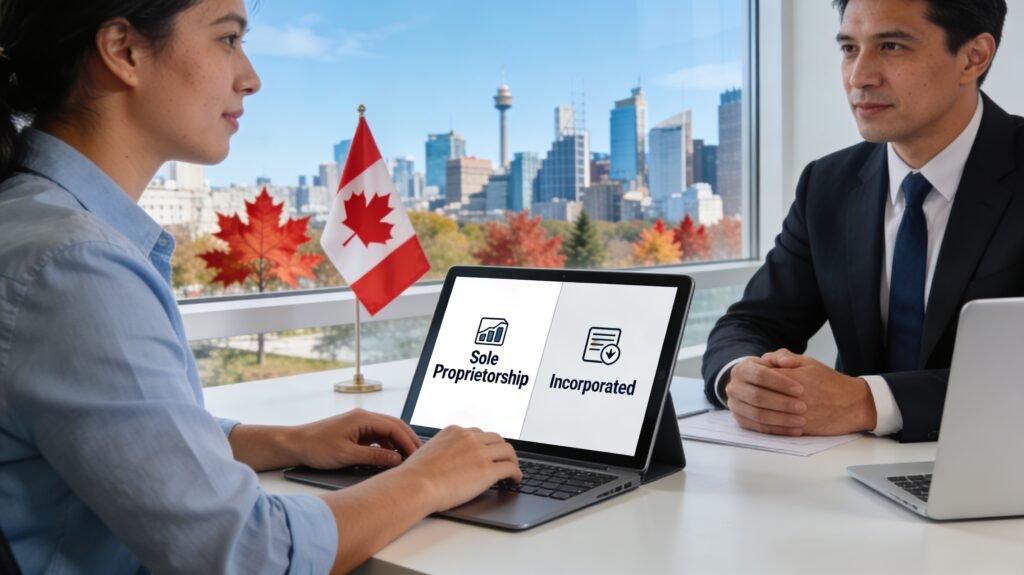
1. Overview: Sole Proprietorship vs Incorporation in Canada
A sole proprietorship is an unincorporated business where the owner and the business are legally the same person for tax and legal purposes; all profits and losses flow directly onto the owner’s personal tax return. In contrast, an incorporated business (corporation) is a separate legal entity that files its own corporate tax return and pays tax at corporate rates, while the owner is taxed only on amounts paid out as salary, dividends, or other benefits.
Both structures can claim a wide range of business deductions, but the timing and level at which tax is paid differ significantly. BOMCAS Canada works with clients across Canada who operate as sole proprietors and corporations, providing bookkeeping, tax preparation, payroll, and planning services for each structure.
2. How Income Is Taxed
2.1 Sole Proprietorship Taxation
Sole proprietors report their business income and expenses on their personal T1 income tax return using the T2125 Statement of Business or Professional Activities. All net profit from the business is taxed in the year it is earned at the owner’s marginal personal tax rate, which can be quite high for successful businesses.
There is no ability to defer tax by leaving profits in the business; every dollar of profit is effectively personal income for that year. This can be advantageous at low income levels but becomes expensive as income grows.
2.2 Corporate Taxation
A corporation files a separate T2 corporate income tax return and pays tax on its profits at corporate tax rates. For Canadian‑controlled private corporations (CCPCs) with active business income eligible for the Small Business Deduction, the combined federal and provincial tax rate on the first tier of active income is often significantly lower than top personal rates.
The owner is then taxed personally only on amounts withdrawn from the corporation—salary, dividends, or other taxable benefits—creating opportunities to manage when personal tax is incurred. BOMCAS Canada helps clients design compensation strategies using salary and dividends that coordinate corporate and personal taxes.
3. Tax Rate Comparison and Deferral
3.1 Personal Marginal Rates for Sole Proprietors
Because sole proprietors pay tax at personal marginal rates, the more profit they earn, the higher their tax rate becomes. In many provinces, top combined federal‑provincial personal rates can exceed 50 percent on the highest income brackets.
For a growing business where the owner does not need all profits for living expenses, paying this high personal rate on every dollar of profit can be inefficient.
3.2 Corporate Rates and the Small Business Deduction
Eligible CCPCs benefit from the Small Business Deduction (SBD) on active business income up to a certain limit (for example, 500,000 dollars federally), which is taxed at a preferential, lower corporate rate. Income above that threshold is taxed at the higher general corporate rate but still usually below top personal rates.
This creates a tax deferral advantage: when profits are retained in the corporation rather than fully paid out, the initial tax hit is at the lower corporate rate, and personal tax is only paid later when funds are withdrawn. BOMCAS Canada models this deferral numerically for clients so they can see the cash‑flow impact of incorporating.
4. Using Losses: Start‑Up and Early‑Stage Businesses
4.1 Losses as a Sole Proprietor
A key advantage of operating as a sole proprietor in the early years is that business losses can be applied directly against the owner’s other sources of personal income, such as employment or investment income. This can reduce overall tax payable and generate refunds when start‑up losses are significant.
For example, if a sole proprietor has a net business loss and employment income, the business loss can offset some or all of that employment income for tax purposes.
4.2 Losses in a Corporation
Corporate losses are trapped inside the corporation and cannot be used to offset the shareholder’s personal income in the same year. Non‑capital losses can often be carried back or forward within the corporation to offset corporate income in other years, but they do not create immediate personal tax relief.
For this reason, some businesses start as sole proprietorships during high‑loss phases and incorporate once they become consistently profitable, often with guidance from a tax professional. BOMCAS Canada frequently helps owners plan this transition and manage rollover steps.
5. CPP, Payroll, and Owner Compensation
5.1 Sole Proprietor CPP Contributions
Sole proprietors pay both the employer and employee portions of Canada Pension Plan (CPP) on their net self‑employment income, up to the annual CPP contribution limits. This effectively doubles the CPP rate compared to employees, increasing the total cost of compensation.
CPP contributions can help build retirement benefits, but they also represent a cash cost that might alternatively be saved in other vehicles.
5.2 Compensation from a Corporation
In a corporation, the owner can choose to pay themselves salary, dividends, or a combination. Salary is deductible to the corporation and subject to CPP contributions (employer and employee portions), while dividends are not subject to CPP but are paid from after‑tax corporate profits.
Balancing salary and dividends allows owners to control CPP contributions, RRSP contribution room, and the timing of personal tax. BOMCAS Canada assists with designing tax‑efficient compensation strategies and handling payroll compliance.
6. GST/HST and Other Indirect Taxes
Regardless of structure, businesses that exceed 30,000 dollars in worldwide taxable supplies in a 12‑month period generally must register for GST/HST and charge it on applicable sales. This obligation applies to both sole proprietors and corporations.
The structure does not change the rules for GST/HST registration or remittance, but incorporation may influence how records are maintained and how input tax credits are tracked. BOMCAS Canada helps both sole proprietors and corporations set up compliant GST/HST systems and file returns accurately.
7. Administration, Compliance, and Accounting Costs
7.1 Simplicity of Sole Proprietorships
Sole proprietors generally face less paperwork: they file only a personal tax return (T1) with the T2125 business statement, and there is no separate corporate return or minute book to maintain. Registration fees are low and ongoing legal obligations are minimal compared to corporations.
Accounting can still be complex when revenue grows, but basic compliance costs are lower, which appeals to very small or part‑time businesses.
7.2 Added Compliance for Corporations
Corporations must maintain a corporate minute book, file annual corporate tax returns (T2), and often file separate provincial corporate annual returns. They also need separate bank accounts and accounting records to clearly distinguish corporate finances from personal finances.
These obligations increase accounting and legal costs but are usually justified once the tax and liability benefits of incorporation are needed. BOMCAS Canada provides corporate year‑end, bookkeeping, and compliance services designed to keep these obligations manageable for small and medium‑sized businesses.
8. Liability and Risk (Beyond Tax but Highly Relevant)
Although this guide focuses on taxes, liability is closely tied to the choice of structure. Sole proprietors have unlimited personal liability for business debts and obligations, meaning personal assets can be at risk if the business is sued or cannot meet its obligations.
Corporations provide limited liability protection in many cases because the corporation is a separate legal person; shareholders’ personal assets are generally shielded from business creditors, subject to certain guarantees and statutory director liabilities. BOMCAS Canada often works alongside legal advisors to help clients evaluate both tax and liability considerations when deciding whether to incorporate.
9. Practical Tax Scenarios: When Each Structure Makes Sense
9.1 Scenario A: Early‑Stage or Side Business
When a business is small, part‑time, or likely to generate losses in the early years, operating as a sole proprietor can make sense because losses can offset the owner’s other income and compliance is simpler. The owner can revisit incorporation once revenue and profit become more predictable.
BOMCAS Canada supports many clients who begin as sole proprietors and provides guidance on bookkeeping, GST/HST, and annual T1 filings.
9.2 Scenario B: Growing Profitable Business
As profits grow beyond the owner’s personal spending needs, incorporation can provide meaningful tax deferral by keeping surplus profits inside the corporation at lower corporate tax rates. The owner can then pay themselves strategically through salary and dividends.
A growing business may also face more contractual risk, employees, or financing needs, where a corporate structure better supports growth and credibility. BOMCAS Canada works with these businesses to implement incorporation, handle rollovers where appropriate, and set up proper corporate accounting systems.
9.3 Scenario C: Professional Practice or High‑Risk Business
Professions and industries with higher liability risk or regulatory requirements often favor incorporation for both tax and legal reasons. In these cases, corporate structures, professional corporations, and multi‑entity setups may all be part of the planning.
BOMCAS Canada collaborates with legal and financial partners where needed to structure these arrangements and provide ongoing corporate tax and accounting support.
10. Switching from Sole Proprietorship to Corporation
10.1 When to Consider Switching
A common rule of thumb is that incorporation becomes more attractive when the business consistently earns more than the owner needs to live on, allowing profits to remain inside the corporation and benefit from lower corporate tax rates. Other triggers include hiring employees, signing larger contracts, or taking on more risk.
Owners should consider timing the switch to align with their fiscal year, cash flow patterns, and major contracts, to minimize disruption and optimize tax outcomes.
10.2 Tax Considerations in the Transition
Transferring assets and operations from a sole proprietorship to a new corporation can often be done on a tax‑deferred basis using a rollover under the Income Tax Act, but this requires proper planning and documentation. Issues such as goodwill, inventory, and capital assets must be addressed.
BOMCAS Canada assists with planning and coordinating the transition, ensuring that bookkeeping systems, GST/HST registrations, payroll, and banking are updated, and that both the final sole proprietor year and the first corporate year are filed correctly.
11. How BOMCAS Canada Supports Both Structures
BOMCAS Canada is a Canada‑wide accounting and tax firm that provides services to sole proprietors, partnerships, and corporations, including bookkeeping, payroll, GST/HST returns, year‑end financial statements, and tax preparation. The firm serves clients virtually across the country and through its Alberta offices, making it accessible to business owners in multiple provinces.
Because BOMCAS Canada works with both incorporated and unincorporated businesses, it can provide unbiased advice on when to incorporate, how to structure compensation, and how to handle the tax transition. Business owners can learn more about services and book a consultation by visiting the main site at https://bomcas.ca.
12. Key Takeaways for Canadian Business Owners
- Sole proprietorship offers simplicity, lower upfront costs, and the ability to use start‑up losses against other personal income, but all profits are taxed immediately at personal rates and the owner has unlimited liability.
- Incorporation adds paperwork and compliance costs but provides limited liability, access to lower corporate tax rates on active business income, and opportunities to defer tax by retaining earnings in the corporation.
- The best choice depends on income level, profit stability, risk, long‑term goals, and whether there is surplus cash that can be left in the business.
Working with an experienced accounting firm like BOMCAS Canada allows business owners to evaluate these factors in detail, forecast tax outcomes under each structure, and implement a tailored plan. Starting at https://bomcas.ca, entrepreneurs can get professional guidance on whether to stay a sole proprietor, incorporate now, or plan a future transition.










 View Our Location





 181 Meadowview Bay, Sherwood Park, AB T8H 1P7, Canada (Online Clients Only)