



By Dellendo Farquharson, BOMCAS Canada
Quick answer: The 1099-K threshold 2026 for payment apps and marketplaces (TPSOs) requires Form 1099-K only when gross reportable payments exceed $20,000 and transactions exceed 200. Card processors still report with no de minimis threshold. Getting a 1099-K—or not—does not decide taxability; report all goods-and-services income.
Tax year: 2026 calendar year (forms issued in early 2027) Last researched: November 1, 2026 (America/New_York), against IRS instructions and newsroom pages
If you sell on marketplaces, take Venmo or PayPal for gigs, drive for a platform, or run a card terminal in a shop, November is when you should stop guessing what January’s mail will say. The Form 1099-K rules bounced around for several years. For 2026, the IRS instructions and FAQs are back on the classic $20,000 and 200 transactions test for third-party network deals—and that is a both / and test, not an either / or.
This article is for freelancers, online sellers, small retailers, and Canadian residents with U.S. platform income. It is general information, not a review of your specific Form 1099-K.
What Form 1099-K actually reports
IRS’s “Understanding your Form 1099-K” page describes the form as a report of payments you received for goods or services through:
- credit, debit, or stored-value cards (payment cards)
- payment apps or online marketplaces, also called third-party settlement organizations (TPSOs)
The payment settlement entity must send you a payee statement by January 31 (for 2026 forms, that is Monday, February 1, 2027, because January 31, 2027 falls on a Sunday — IRC section 7503 and the General Instructions for Certain Information Returns move weekend deadlines to the next business day). It generally files with the IRS by February 28 on paper (for 2026 forms, Monday, March 1, 2027, because February 28, 2027 is also a Sunday) or by March 31 if filed electronically (Wednesday, March 31, 2027 — that date stays put). You use the form with your own books to figure taxable income. The form is an information return, not a bill and not a final determination of profit.
Gross amount in box 1a means the total reportable payment transactions without subtracting fees, refunds, shipping, discounts, or chargebacks. That single design choice is why so many people panic when the form looks larger than their bank deposits.
The 2026 threshold in plain English
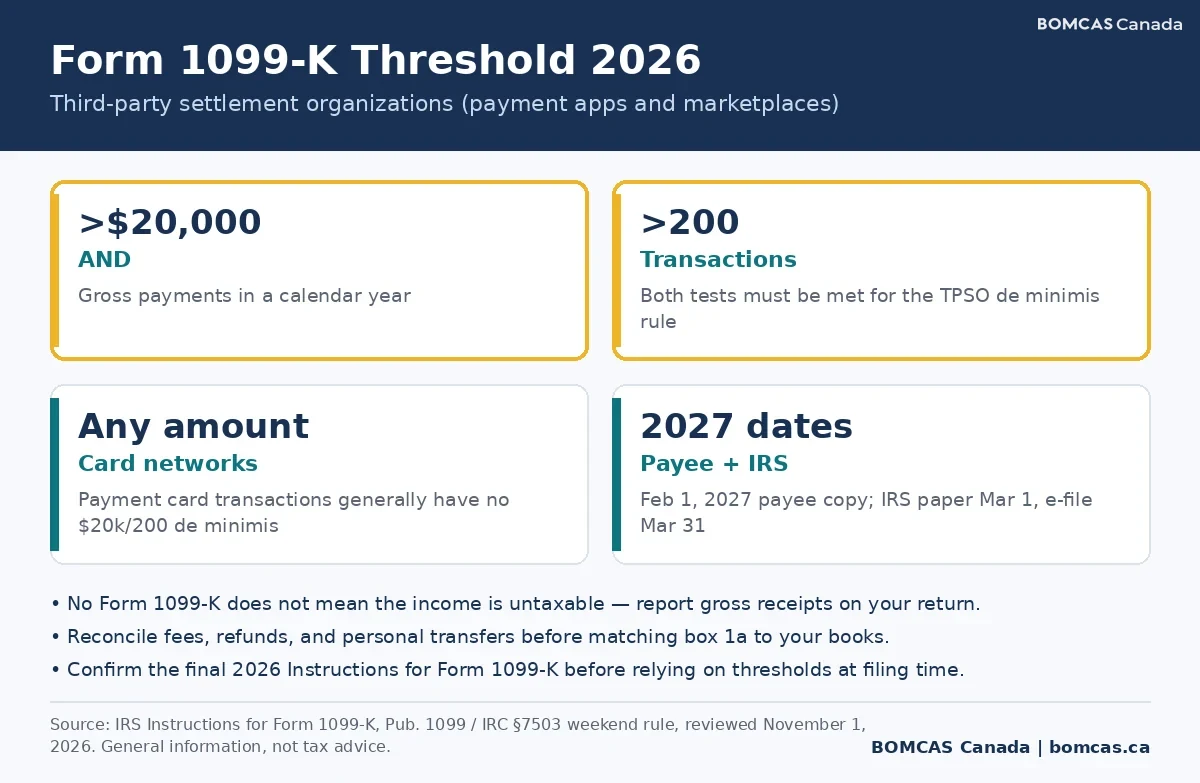
Third-party network transactions (apps and marketplaces)
The Instructions for Form 1099-K (revised 12/2026) and Publication 1099 (2026) say a TPSO must report third-party network transactions for a participating payee only if, for the calendar year:
- the gross amount of total reportable payment transactions exceeds $20,000, and
- the total number of such transactions exceeds 200.
Both conditions must be met before the TPSO is required to file for that payee. IRS newsroom Fact Sheet coverage of the One, Big, Beautiful Bill (P.L. 119-21) confirmed that the law restored this pre-ARPA threshold.
Important practical caveats
- A platform may still send a 1099-K below the threshold. IRS tells payees that lower amounts or fewer transactions can still produce a form.
- Whether or not you receive a form, income from selling goods or services is still reportable on your return.
- Personal gifts and shared expense reimbursements from friends and family should not be business 1099-K amounts. Tag those payments as personal in the app when you can.
Payment-card transactions are different
If customers pay you directly by credit, debit, or gift card through a merchant processor, IRS says you get a Form 1099-K from the processor no matter how many payments you received or how much they were for. The $20,000 / 200 de minimis rule is a TPSO network rule, not a free pass for every card terminal.
If you have both card and network activity for the same payee, the instructions require separate Forms 1099-K for each type.
Why the threshold kept changing—and why 2026 sellers still care
Congress and the IRS moved the reporting trigger more than once after the American Rescue Plan tried to drop it toward $600. Many sellers spent 2022–2025 reading headlines that did not match the form that actually arrived. For planning the rest of 2026, use the current instructions: over $20,000 and over 200 transactions for TPSO reporting requirements.
Do not build your tax life around avoiding a form. Build it around clean books. A seller with $18,000 of platform sales and excellent records is in better shape than a seller with $40,000 of sales and a shoebox.
Box-by-box items worth understanding before year-end
You do not need to memorize the entire instructions, but a few boxes drive most reconciliation work:
- Box 1a – Gross payment card / third-party network transactions. Starting point; fees are not netted.
- Box 1b – Card-not-present transactions. Online, phone, or keyed sales subset.
- Box 1c – Cash tips. Added under P.L. 119-21 reporting for cash tips included in box 1a.
- Box 1d – Treasury Tipped Occupation Code(s). Occupation codes for tipped activity.
- Box 3 – Number of payment transactions. Count of payment transactions, not including refunds.
- Box 4 – Federal income tax withheld. Backup withholding if a TIN problem triggered withholding.
- Boxes 5a–5l – Monthly amounts. Useful when your books are monthly and the annual total looks wrong.
If backup withholding appears, fix your TIN and withholding status with the platform quickly. Waiting until you file the 1040 rarely unwinds the cash that was already sent to the IRS.
Income vs. proceeds: the reconciliation most people skip
A 1099-K can include:
- sales of inventory
- sales of services
- sales of used personal items
- amounts that later were refunded
- gross charges before seller fees
Your taxable income is not automatic box 1a.
Business and gig sellers
Start with gross receipts, subtract returns and allowances, cost of goods sold, and ordinary expenses. Keep platform fee statements; those fees are usually deductions, not silent reductions of box 1a.
Personal-item sellers
IRS reminds taxpayers that selling personal items can still produce taxable gain. Selling at a loss generally does not create a deductible personal loss. If a 1099-K includes personal sales mixed with business sales, separate them in your workbook before you file.
Canadians with U.S. platform income
A Canadian resident who sells into U.S. marketplaces may receive a U.S. Form 1099-K while still filing a Canadian T1 and, when required, a U.S. nonresident or resident return. Treaty position, U.S. trade or business status, and GST/HST on Canadian sales are separate questions. For orientation, see A Canadian’s guide to cross-border tax planning for U.S. compliance and cross-border tax planning for U.S.–Canada families.
November and December actions that prevent January chaos
- Download year-to-date platform summaries now. Do not wait for the official form.
- Count transactions the way the platform counts them. The 200-transaction test is about the network’s reportable transactions, not your invoice count if those differ.
- Separate personal transfers in every payment app. Add notes today, not in April.
- Reconcile fees, refunds, and chargebacks monthly so box 1a is not a surprise.
- Match contractor payments you make to others. If you pay U.S. contractors by card or platform, those amounts may belong on their 1099-K from the processor, not on your 1099-NEC. Keep payer files tidy with the same discipline as bookkeeping cleanup for tax season, and use best bookkeeping practices for small business to separate platform deposits from expense accounts before January.
- Confirm your legal name and TIN with each platform so January does not start with backup withholding.
- If you also run payroll for helpers who are employees, keep that bright line clear. Platform seller status does not turn staff into vendors. See Canada payroll services when the workforce sits on the Canadian side.
- For product businesses, roll inventory and landed cost now. A clean COGS calculation is what turns a scary gross 1099-K into an ordinary business return. Business income tax reporting in Canada is a useful parallel checklist even when the information slip is a U.S. form.
What to do if the form is wrong
IRS’s 1099-K help pages walk through common errors: personal payments included, wrong amounts, or duplicate forms. In practice:
- Compare the form to your own export from the platform.
- Contact the filer’s phone number on the form promptly.
- Keep a written timeline of the dispute.
- File your return with the correct taxable income and explain the mismatch if needed; do not invent income just to match a bad slip, and do not omit income just because a slip is missing.
If federal tax was withheld in box 4, keep the form even while you dispute other boxes—you will need it to claim the withholding.
How this fits with other 2026 information returns
Publication 1099 (2026) also raised many other information-return dollar thresholds to $2,000 for tax years beginning after 2025 (inflation-adjusted after that). That $2,000 figure is a different rule from the 1099-K TPSO test. Do not mix them up when you build your January filing list for 1099-NEC, 1099-MISC, and 1099-K.
Payment-card and third-party network payments that are reportable under section 6050W are generally reported on 1099-K rather than on 1099-NEC / 1099-MISC under sections 6041 or 6041A. If you are the payer, knowing which form the processor already files keeps you from double-reporting.
For U.S. individual filing context from BOMCAS, see U.S. tax for individuals and Edmonton Alberta U.S.A. tax services.
Frequently Asked Questions
What is the Form 1099-K threshold for 2026?
For third-party settlement organizations, IRS instructions require reporting when gross reportable payments exceed $20,000 and transactions exceed 200 in the calendar year. Both must be met for the TPSO filing requirement.
Can I get a 1099-K if I am under the threshold?
Yes. IRS says a platform may still issue a form for lower amounts or fewer transactions. Report your income either way.
Do credit-card sales have a $20,000 minimum?
No. Direct payment-card settlement is reported without that de minimis threshold.
Is the amount on Form 1099-K my taxable profit?
No. Box 1a is gross reportable payments before fees, refunds, and expenses. Your taxable income depends on your facts and records.
When should I receive the 2026 Form 1099-K?
The filer must normally send your copy by January 31. For 2026 forms, that is Monday, February 1, 2027, because January 31, 2027 falls on a Sunday (IRC section 7503 / General Instructions for Certain Information Returns: next business day). The IRS copy is normally due February 28 on paper or March 31 electronically; for 2026 forms that is Monday, March 1, 2027 for paper (February 28, 2027 is a Sunday) and Wednesday, March 31, 2027 for e-file.
I am in Canada and sell on a U.S. marketplace. Does this still matter?
Yes. You may receive a U.S. Form 1099-K, and you still need to place the income correctly under Canadian and, where applicable, U.S. filing rules.
Talk to BOMCAS Canada
If you need help reconciling a Form 1099-K, separating personal and business platform activity, or coordinating U.S. and Canadian reporting, call BOMCAS Canada at 780-667-5250 or email info@bomcas.ca. Our office is at 6063 – 88 St NW, Edmonton, Alberta T6E 5T4, open 9:00 a.m. to 5:00 p.m. If your platform income lands on a Canadian personal return, our Edmonton personal tax accountant page explains how we can help.
Sources
- IRS, Instructions for Form 1099-K (12/2026), including the de minimis exception (over $20,000 and over 200 transactions). https://www.irs.gov/instructions/i1099k
- IRS, “Understanding your Form 1099-K,” irs.gov/businesses/understanding-your-form-1099-k. Reviewed November 1, 2026.
- IRS, Publication 1099 (2026), General Instructions for Certain Information Returns (1099-K reporting; backup withholding notes; $2,000 threshold for certain other information returns). https://www.irs.gov/publications/p1099
- IRS Newsroom, IR-2025-107 (Oct. 23, 2025), FAQs on Form 1099-K threshold under the One, Big, Beautiful Bill; dollar limit reverts to $20,000. https://www.irs.gov/newsroom/irs-issues-faqs-on-form-1099-k-threshold-under-the-one-big-beautiful-bill-dollar-limit-reverts-to-20000
- IRS Form 1099-K landing page and related FAQs at IRS.gov/Form1099K. Reviewed November 1, 2026.








 View Our Location






 181 Meadowview Bay, Sherwood Park, AB T8H 1P7, Canada (Online Clients Only)