



By Dellendo Farquharson, BOMCAS Canada
Quick answer: The Section 179 2026 expensing limit is $2,560,000, phasing out above $4,090,000 of Section 179 property; SUVs cap at $32,000. After Section 179, qualified property acquired and placed in service after January 19, 2025 can generally take 100% bonus depreciation. The asset must be placed in service by year-end, not merely ordered.
Tax year: 2026 (calendar-year businesses) Last researched: November 1, 2026 (America/New_York), against IRS pages and publications
December is when many owners finally decide whether to buy the truck, CNC machine, dental chair, or server rack they have been pricing all year. The tax rules for 2026 are unusually friendly on paper: a higher Section 179 ceiling than the old $1 million era, and permanent 100% bonus depreciation for eligible property acquired after January 19, 2025. The trap is timing. An invoice dated December 30 does nothing if the asset is still on a truck in January.
This guide is for U.S. trades, professional practices, and Canadian-owned U.S. operations that buy tangible business equipment. It is general information, not a depreciation election for your return. Always match the numbers to Form 4562 and Publication 946 for your exact facts.
What changed heading into 2026 purchases
Two federal changes drive most year-end conversations.
Section 179 limits for 2026
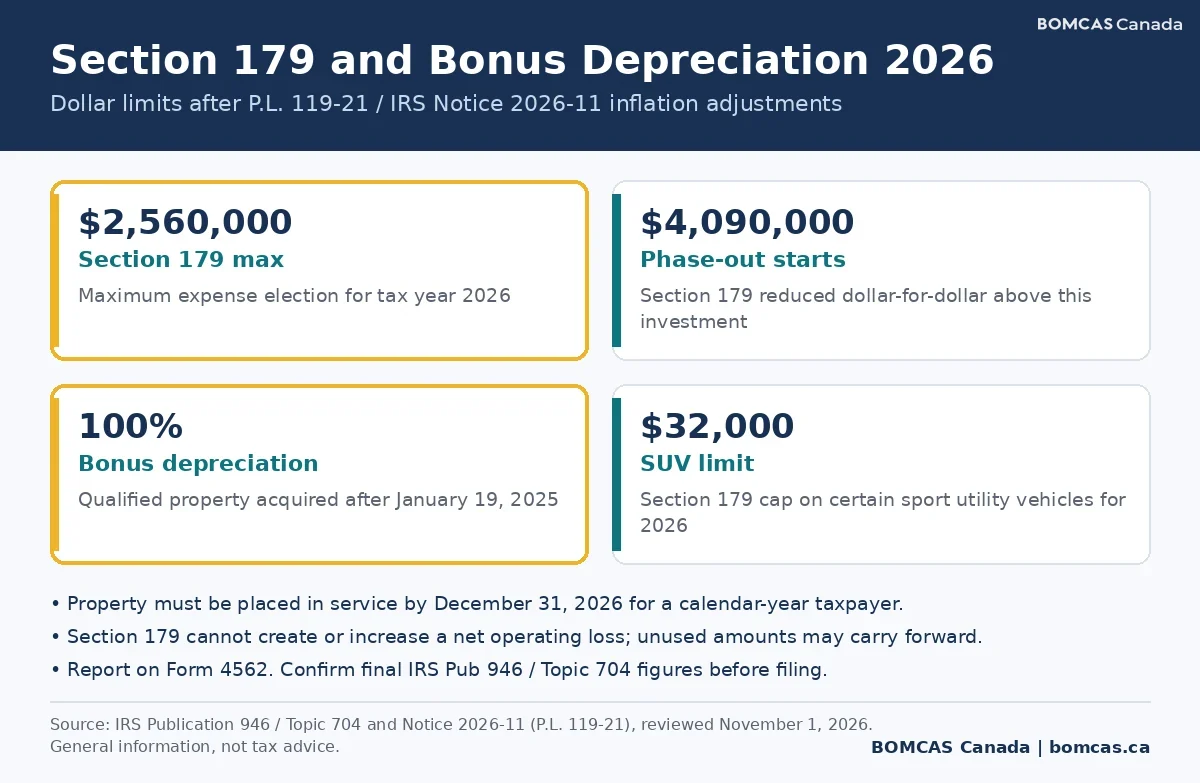
IRS Publication 946’s “What’s New for 2026” and Rev. Proc. 2025-32 set the inflation-adjusted Section 179 figures for tax years beginning in 2026:
- Maximum Section 179 expense deduction: $2,560,000
- Phase-out begins when Section 179 property placed in service exceeds: $4,090,000
- Maximum Section 179 deduction for a sport utility vehicle: $32,000
Those 2026 amounts follow the One, Big, Beautiful Bill Act (P.L. 119-21) increase of the 2025 base limits to $2,500,000 / $4,000,000, then an inflation step for 2026.
Section 179 is also limited by taxable income from the active conduct of a trade or business. You cannot elect more than that income limit allows, even if you are under the dollar cap.
Bonus depreciation at 100% again
IRS Topic No. 704 and Notice 2026-11 explain the restored special depreciation allowance:
- Qualified property placed in service after December 31, 2024, and before January 20, 2025: generally 40% (60% for certain longer production period property and certain aircraft).
- Qualified property acquired and placed in service after January 19, 2025: generally 100%.
For a normal calendar-year business buying equipment in November or December 2026, the acquisition-date test is usually the one that matters: after January 19, 2025, and placed in service in 2026. Topic 704 also notes that the allowance is taken after any allowable Section 179 deduction and before regular MACRS depreciation.
The OBBB made 100% additional first-year depreciation permanent for eligible property acquired after that January 19, 2025 date, instead of letting the old phase-down continue toward zero.
Section 179 vs. bonus depreciation: which lever to pull
Think of the two rules as a sequence, not a coin flip.
- Elect Section 179 on all or part of the cost of qualifying property, up to the dollar and income limits.
- Apply bonus depreciation to the remaining eligible basis.
- Depreciate anything left under MACRS.
Why businesses still use Section 179
- You can choose which assets get expensed when you buy several items.
- You can expense part of an asset’s cost.
- Qualified improvement property and certain building systems (roofs, HVAC, fire protection, security) can be Section 179 property even when bonus rules are pickier about real property.
- Some state returns still disconnect from federal bonus depreciation; Section 179 planning and state conformity need a separate check.
Why bonus depreciation still matters
- It can cover amounts above the Section 179 dollar cap.
- It does not use the Section 179 taxable-income limitation the same way.
- For large eligible purchases in 2026, 100% bonus can clear remaining basis in the first year after any Section 179 election.
A common pattern for a profitable shop: Section 179 the assets you want to cherry-pick or the qualified real-property improvements, then take 100% bonus on the rest of the eligible personal property.
Placed-in-service is the real deadline
IRS depreciation rules look at when the asset is ready and available for its specific use, not when you signed the purchase order or paid a deposit.
Before you rely on a 2026 deduction:
- Confirm delivery and installation in 2026.
- Confirm the asset is available for use in the business in 2026.
- Keep the bill of sale, delivery ticket, serial numbers, and photos or commissioning records.
- If financing is involved, make sure ownership and placed-in-service facts still support the deduction you plan to claim.
Ordering a machine on December 28 for February installation is a 2027 placed-in-service story for a calendar-year taxpayer, no matter how eager the salesperson is to “lock in this year’s write-off.”
What usually qualifies—and what gets people in trouble
Typically eligible tangible property
Machinery, equipment, off-the-shelf computers and peripherals, office furniture, and many vehicles used in business can qualify, subject to listed-property and vehicle caps. Topic 704 notes that computers and related peripheral equipment are not listed property under current rules, which removes one old compliance headache.
Listed property and vehicles
Cars and other listed property still have extra substantiation and, for passenger autos, separate depreciation dollar caps. The Section 179 SUV limit of $32,000 for 2026 is not a free pass around every vehicle rule. Heavy vehicles that escape passenger-auto treatment still need a hard look at gross vehicle weight, business-use percentage, and documentation.
Buildings and land
Land is never depreciable. A new building is not a simple Section 179 write-off. Qualified improvement property and the listed building systems can be Section 179 property when they meet the statutory definitions, but “we renovated the shop” is not enough—you need cost segregation-level clarity between structural components and eligible improvements.
Used property
Both Section 179 and bonus depreciation can apply to used property when the acquisition and original-use / acquisition tests in the Code and regulations are met. Related-party deals and property you previously used can fail those tests. Do not assume a purchase from a related company qualifies.
A practical November–December decision framework
1. Forecast taxable income first
Section 179 dies against the income limitation. If 2026 is a thin year, a huge election may simply carry over. Bonus depreciation can create or increase a loss in ways Section 179 cannot; that may be good or bad depending on your other 2026 income, loss limits, and future rate expectations.
2. List every planned purchase with a realistic in-service date
Split the list into:
- can be installed and used in 2026
- will slip into 2027
- maybe, if the vendor hits a date
Only the first group belongs in the 2026 model.
3. Separate “want” from “need”
Tax should not force a bad operational purchase. A write-off on idle equipment is still a cash outflow today.
4. Check bookkeeping and fixed-asset readiness
Year-end fixed-asset schedules are only as good as the invoice coding behind them. If your books are behind, fix that before you file Form 4562. BOMCAS’s notes on bookkeeping cleanup for tax season and best bookkeeping practices for small business apply as much to U.S. equipment purchases as to Canadian month-end close.
5. Coordinate payroll and owner cash needs
Buying equipment with operating cash can collide with payroll deposits, estimated taxes, and owner draws. If you run U.S. or Canadian payroll alongside the purchase, keep remittance dates visible—see Canada payroll services for the Canadian side of mixed operations.
6. Cross-border owners: model both countries
Canadian residents who own U.S. disregarded LLCs or corporations often see a large federal depreciation deduction on the U.S. side while Canadian reporting follows different capital-cost rules. Read the purchase through both lenses before you celebrate the U.S. write-off. Start with A Canadian’s guide to cross-border tax planning for U.S. compliance and advanced tax strategies for Canadian companies expanding to the U.S..
Form 4562 and records you should build now
When you file, Section 179 and special depreciation are reported on Form 4562. Build the binder while the purchase is happening:
- invoice and proof of payment
- delivery and installation evidence
- business-use log for vehicles
- written Section 179 election detail (assets and amounts)
- note on whether bonus depreciation is claimed or elected out for a class of property
- state conformity checklist
If you later dispose of the asset, Section 1245 recapture can turn an early expensing win into ordinary income. Keep the fixed-asset file for the life of the asset, not just until the 2026 return is accepted.
For entity-level U.S. business filing help from the Canadian side of the border, see Edmonton Alberta U.S.A. tax services and U.S. tax services for business.
Mistakes we see every January
- Treating a deposit as placed-in-service.
- Ignoring the $4,090,000 phase-out when several related entities or a big expansion land in the same year.
- Applying the full Section 179 limit to an SUV that is capped at $32,000.
- Forgetting taxable-income limits and wondering why the software capped the election.
- Claiming 100% bonus on property acquired under a pre–January 20, 2025 binding contract without reading the acquisition-date rules.
- No mileage or business-use log for a “company” vehicle that is clearly mixed-use.
- Buying personal toys through the business and hoping depreciation cleans it up.
Frequently Asked Questions
What is the Section 179 limit for 2026?
For tax years beginning in 2026, the maximum Section 179 deduction is $2,560,000. It phases out dollar-for-dollar once Section 179 property placed in service exceeds $4,090,000. The SUV Section 179 cap is $32,000.
Is bonus depreciation 100% in 2026?
For qualified property acquired and placed in service after January 19, 2025, IRS Topic No. 704 says the special depreciation allowance is 100%. Property placed in service after December 31, 2024, and before January 20, 2025, was generally at 40% (60% for certain long-production property and aircraft).
Do I take Section 179 or bonus first?
Topic 704 says the special depreciation allowance is taken after any allowable Section 179 deduction and before other depreciation.
Does the asset have to be new?
Not necessarily. Used property can qualify when the acquisition and use tests are met. Related-party and previously used property are common failure points.
What if I buy in 2026 but install in 2027?
For a calendar-year taxpayer, a 2027 placed-in-service date generally pushes the deduction to 2027, even if you paid in 2026.
Can Canadian-owned U.S. businesses use these rules?
Yes, on the U.S. return, when the U.S. trade or business and the property otherwise qualify. Canadian tax depreciation is separate and must be modelled on its own.
Talk to BOMCAS Canada
Planning a year-end equipment buy, a Form 4562 election, or a cross-border purchase through a U.S. entity? Call BOMCAS Canada at 780-667-5250 or email info@bomcas.ca. Our office is at 6063 – 88 St NW, Edmonton, Alberta T6E 5T4, open 9:00 a.m. to 5:00 p.m. For the Canadian side of a cross-border business, see our Edmonton corporate tax accountant services.
Sources
- Internal Revenue Service, Topic No. 704, Depreciation, irs.gov/taxtopics/tc704 (Section 179 overview; 40% vs 100% special depreciation allowance; ordering rules). Reviewed November 1, 2026.
- IRS, Publication 946, How to Depreciate Property (2025), “What’s New for 2026” Section 179 dollar limits ($2,560,000 / $4,090,000 / $32,000 SUV). https://www.irs.gov/pub/irs-pdf/p946.pdf
- Rev. Proc. 2025-32, 2025-45 I.R.B. 695 (2026 inflation-adjusted Section 179 amounts). https://www.irs.gov/irb/2025-45_IRB and https://www.irs.gov/pub/irs-drop/rp-25-32.pdf
- IRS Notice 2026-11, interim guidance on additional first-year depreciation under §168(k) after P.L. 119-21. https://www.irs.gov/pub/irs-drop/n-26-11.pdf
- IRS Newsroom, “Treasury, IRS issue guidance on the additional first year depreciation deduction amended as part of the One, Big, Beautiful Bill,” irs.gov/newsroom. Reviewed November 1, 2026.
- IRS, “Working Families Tax Cuts – Businesses,” Section 70306 summary of Section 179 increases. Reviewed November 1, 2026.









 View Our Location






 181 Meadowview Bay, Sherwood Park, AB T8H 1P7, Canada (Online Clients Only)